Wednesday, April 11, 2012

Showery Session

A forecast of April showers saw me avoid the open coast and instead head inland to Out Rawcliffe where if need be there’s a few trees to provide shelter. I topped up the Goldfinch’s Niger feeders and then scouted around for “owt about” and a possible ringing session on Thursday. 

It was still fairly quiet in our plantation although the male Willow Warblers had arrived in recent days, with 3 singing away in the annual spots but otherwise just the tinklings of several Goldfinches. I put a few nets up and then meandered around, and from the top of the moss surveyed the landscape in all directions, hoping for some “vis mig” which might involve the redpolls of late March starting up again. 

The views from here are good to the east, south and west, less so to the north, and with little traffic noise its usually quiet enough to hear birds overhead in spring or autumn. I caught 4 new Goldfinch and a recaptured a Willow Warbler first ringed here in 2011, but no more of our annual and now serial visitors yet. In fact as heavy clouds rolled in from the west I decided discretion to be the better option so took the nets down; in the nick of time as it proved when a heavy hail storm turned quickly into substantial rain just as I stuffed the nets in their bags. 

Willow Warbler

My wanderings produced a good mix of birds but nothing in the way of overhead migration and no Lesser Redpolls, just a single Siskin. On the recently ploughed fields I found 16 Fieldfare together with 2 pairs of Grey Partridge and 60+ still flocking Woodpigeon, and on the grassy fields, 40+ Curlew, 4 Lapwing, 2 Skylark and 12 Shelduck. Raptors entered in the notebook were 3 Buzzard, 1 Sparrowhawk and 1 Kestrel, with one Little Owl at the barn early doors. 

 Grey Partridge

Little Owl
 
Other singers this morning included a trio of farmland buntings in 3 Yellowhammer, 1 Reed Bunting and 1 Corn Bunting, the latter singing in the April rain from a broken off stem of last year’s maize crop. 

 Corn Bunting

The forecast is slightly better for Thursday and whilst as the saying goes,“April showers bring May flowers”, birders prefer to believe that April showers bring May birds in early, so stay tuned for more news and pictures soon.

Tuesday, April 10, 2012

First Wheat Et All

With it being cold and blowy again this morning I left the birding until pm. Temperatures were a little better after lunch, high enough even to make the meal worms wriggle. I located a single male Wheatear at Pilling Water, and then three minutes later the bird had a brand new shiny ring as it headed off east towards the hills. Although a bright, colourful adult male it was of only average bulk and 100 mm wing chord so was clearly of the UK variety; true Greenland types, wing >105mm are not normally due until later in the month. 

 Wheatear

Wheatear

A few bits and pieces on and around the incoming tide, including a good count of 430+ Redshanks. Others: 7 Red-breasted Merganser, 15 Oystercatcher, 2 Eider, 20 Grey Plover, 110 Golden Plover, 2 Little Egret, 45 Lapwing, 20 Curlew, 7 Cormorant, 4 Skylark, 2 Pied Wagtail, 2 Linnet and 4 Meadow Pipit. 

 Redshank

As I sat below the sea wall 3 Swallows came from the south and headed directly across the bay towards Heysham, my first hirundines of the year. 

Back at the car park a Willow Warbler sang out loud and clear, another new one for the year! 

 Willow Warbler

Heading back home the Buzzard was over Burned House Lane again. 

Sunday, April 8, 2012

Merlins And Moles

I squeezed a few hours birding in despite the cold, grey, breezy start, a brighter middle and then more drizzle to end on, so there’s not a lot to report – again. 

As I drove along Burned House Lane I glanced sideways at a Buzzard descending amongst corvids where I guessed a dead rabbit was about to be claimed, but the double white lines here preclude any stopping to bird watch. Between Lambs Lane and Fluke hall Lane I added 4 Kestrels to the note book, two separate pairs hunting their territories, then along Fluke Hall Lane I thought there was another Kestrel atop a telegraph pole. On closer inspection it turned out to be a Merlin; a pity about the grey light, the necessary overexposure and ISO 800 followed by Photoshop. Stop making excuses! 

Merlin

I know one or two of my blog readers have an aversion to Merlins and perhaps birds of prey in general, but a Merlin is my favourite bird of prey, so completely fearless, dashing and spectacular is it when hunting. Some regard the North American and Eurasian Falco columbarius populations as two distinct species, a bird with a long-standing presence on both sides of the Atlantic, as demonstrated by the degree of genetic differences between Eurasian and North American populations. Right now the splitters, in particular the Scilly tickers (or is that Silly Tickers?), argue the Merlin might be considered two distinct species, with gene exchanges probably having ceased at least a million years ago. 

The Merlin sped off across Hi-Fly’s now partly ploughed fields, setting to flight the several Lapwings, Oystercatchers, Redshanks and Skylarks. 

In the village Woodpigeons, Collared Doves and Jackdaws prowled around the Golden Ball’s beer tables looking for crumbs of Golden Wonder or Uncle Albert’s Pork Scratchings. Funny how normally shy birds are less fearful when there may be food about. Now there’s a tricky exposure – black and grey bird, half of it against the grey slate roof, the other half against a grey sky – well done Canon. 

  Jackdaw

The Pilling Water/Fluke walk proved to be mainly that, a walk, with no sign of fresh springtime birds just winter ones or recent arrivals: 2 Little Egret, 2 Little Grebe, 3 Tufted Duck, 3 Jay, 14 Chaffinch, 1 Reed Bunting, 2 Meadow Pipit, 3 Skylark, 7 Teal, 1 Greenshank. 1 more Kestrel and now 250 Pink-footed Goose. 

 Kestrel

I came across a trophy wire of freshly killed moles – European Mole Talpa europaea

 European Mole Talpa europaea.

A mole's diet is mostly earthworms and other small invertebrates found in the soil. Mole runs are in reality 'worm traps', the mole sensing when a worm falls into the tunnel then quickly running along to kill and eat it. Moles cause damage and alarm to gardeners and green keepers when they appear unexpectedly leaving a trail of mole hills in their wakes. 

Killing and then displaying the pathetic little corpses is a throwback from the days when gamekeepers had to display dead "vermin" to justify their employment and show how efficient they were. Surely In this day and age it is both unjustified and inexcusable that anyone still does this?

Friday, April 6, 2012

Back To Winter Questions

It was back to a couple of hours birding at Pilling this morning complete with bobble hat, gloves and a woolly scarf to ward off the cold. And if any birds made it up here against the unfriendly north westerly winds and through the obstructive high pressure then I didn’t find any of them this morning, and here on April 6th I’ve yet to see a Swallow or a Willow Warbler.

The trees at Fluke Hall were devoid of any warbler melodies, with just the sounds of Blackbird, Song Thrush, Chaffinch, Goldfinch, Dunnock, Robin, and all four of the titmice family. At the west end of the wood I came across a flock of 22 Linnets, a single Meadow Pipit and the pair of hedgerow dwelling Reed Buntings. 

 
Robin 

Blue Tit

My Lane Ends/Pilling Water walk produced a few of the usual bits and pieces with on the pools 2 Little Grebe, 2 Tufted Duck and 2 Little Egret sheltering in the lee of the bank. There seemed to be a few Meadow Pipits heading out across the bay, and as I watched them struggle into the wind I heard a Siskin overhead. When I looked up there were 5 of them, seemingly headed in the same direction as the pipits but within a few seconds they turned, circled and then dropped back into the trees. I could hear the Jays again noisily making their way through the trees and when I found them I saw there were three.

The walk to Pilling Water turned up little, the highlight being a single spring Wheatear, contrasting with the remnants of the wintering Pink-footed Geese, still about 350 birds. On the wildfowler’s pools 13 Teal still linger with approximately 25 Redshank for company, in a group, just waiting to head north to Iceland. Small birds were hard to come by here with a single Meadow Pipit and 4 Skylark, and after their bursts of song in recent times the local Skylarks went silent with the cold winds, with now just the noise of their territorial squabbles confirming they are still about. 

 Wheatear

As I journeyed back to Lane Ends I disturbed a Kestrel from the fence posts and then noted a sentinel Peregrine out on the marsh, whilst above the plantation a Buzzard circled and mewed.


A couple of questions sprang to mind: When a Buzzard calls from a great height, to what distance does the call travel? Are Buzzards breeding in Pilling village now?

Wednesday, April 4, 2012

Goldfinch News

Today we pay the price for the week or two of fine weather as cold northerly winds with snow hit Cumbria, Yorkshire and Derbyshire, north, south and east of this coastal location. This April surprise brought down the curtain on any springtime birds likely to head this far north and so put paid to any birding or ringing for me today. 

We received yet another Goldfinch recovery in the south of the UK. L863394, a fresh juvenile bird of the year caught on 2nd September 2011 during one of many ringing sessions at Rawcliffe Moss. It was recaptured at Cadborough, East Sussex just 44 days later on 16 October 2011. On 2nd September Will and I caught a total of 19 Goldfinches, a number which made up the majority of the catch of 31 new birds, so we probably hit an autumn movement of Goldfinches that day. 

During 2011 we ringed 280 Goldfinches at this site and this latest recovery is similar to ones notified in the past which show how Goldfinches from the north of England travel south in the autumn to spend the winter near the south coast and then return north in the spring. Yet others may hop across the English Channel to France, Belgium or Holland and we await a record of this type. I plotted the most recent example on the map below together with others involving the Fylde area of Lancashire. Three of those shown involve birds from Rawcliffe Moss, two individuals from mine and Will’s gardens respectively and the final one a road casualty. Interestingly five examples involve sub-adult females, the road casualty of unknown age. Juvenile and females Goldfinches are known to migrate further than males. 

In recent years the population of Goldfinches has increased tremendously in this part of Lancashire whereby they are now a very common garden bird plus a bird of farmland and woodland edge, all of which makes it possible to catch numbers only dreamt of ten years ago. So all you ringers there in the south of England, keep catching those winter Goldfinches, there’s a good chance one will be recaptured up here or you will find one originally ringed in the Fylde. 

 Goldfinch

Goldfinch movements
 
Those lottis of mine just completed the nest before the cold winds came. The feathers should keep the eggs warm. 

Long-tailed Tit

Sunday, April 1, 2012

It’s No Joke

We met up at 0630 on the frosted moss again for another crack at dawn ringing. With it being April 1st I wasn’t sure if Will was pulling my leg when he said he’d caught and ringed a Snipe on Saturday night instead of staying in and watching the telly. 

The nets went up and then whilst having a warming coffee he showed me the pictures of the Snipe, one of several we’d seen on a tiny flash of water on Saturday when trying to locate the Ring Ouzel. Nice one Will, it is several years since the ringing group had a Snipe on the yearly totals. 

 Snipe

Snipe

Snipe

We turned to the more immediate matters in hand; Sunday morning’s ringing which turned out to be quiet once again, unlike Portland Bill on the south coast of England where on Saturday thousands of migrant birds made landfall. Saturday - “all but impossible to get to a best guesstimate of the numbers but 3000 Willow Warbler/Chiffchaff, 500 Blackcaps, 75 Wheatears and 12 Redstarts seems reasonable at the Observatory where the day’s ringing total reached 615 birds!!” 

Unfortunately none of the thousands of that wave of migrants appeared to have travelled north overnight to the postage stamp of land that is Rawcliffe Moss, Lancashire, so we settled for the somewhat less impressive total of 11 birds, 9 new and 2 recaptures. We did get another 4 Lesser Redpoll together with 4 Goldfinch and 1 Reed Bunting. The 2 recaptures were 1 each of Goldfinch and Dunnock. 
  
 Lesser Redpoll

 Dunnock

Reed Bunting

During the morning there was a small but evident arrival of Lesser Redpolls with probably 25/30 birds overhead during 4 hours. Little other noticeable migration except for a couple of Siskin, 10/12 Meadow Pipit and 2 flights of Golden Plover amounting to circa 50 birds. Other bird watching resulted in 1 Merlin, 1 Little Owl, 1 Kestrel, 2 Great-spotted Woodpecker, 4+ Skylark, 2 Jay, 3 Buzzard, 6 Yellowhammer, 4 Reed Bunting, 2 Mistle Thrush, 4 Grey Partridge.

Saturday, March 31, 2012

Less Lessers

Will and I met up on the moss again today hoping the past week’s abundance of Lesser Redpolls might continue so we could attain the magic 100, but it wasn’t to be. The continuing northerly wind didn’t help our cause with just a small catch of new birds to reward 4+ hours in the field. 

We may have to wait for a change in wind direction before the next wave of redpolls, and at March 31st surely there will be more on the move during April? This morning we managed just 15 birds, 11 new and 4 recaptures. The new birds comprised 8 Goldfinch, 2 Chaffinch and a single Lesser Redpoll. Recaptures: 3 recent Goldfinch and 1 Chaffinch from 2010. 

 Lesser Redpoll

If it hadn’t been for the Niger feeders doing their stuff in attracting Goldfinches and ground feeding Chaffinches our catch would have been abysmal, with very little in the way of visible migration. In comparison to earlier in the week redpolls were conspicuous by their absence with less than 10 birds noted. Meadow Pipit movement was similarly negligible with 10+ birds heading north in 4 hours. 

“Otherwise” sightings: 6 Yellowhammer, 5 Linnet, 1 Corn Bunting, 4 Grey Partridge, 1 Fieldfare, 1 Kestrel, 2 Buzzard, 5 Snipe, 65 Golden Plover flying south, 1 Pied Wagtail, 1 Ring Ouzel briefly. Mammals: 1 Stoat, 20 + Brown Hares. 

 Brown Hare

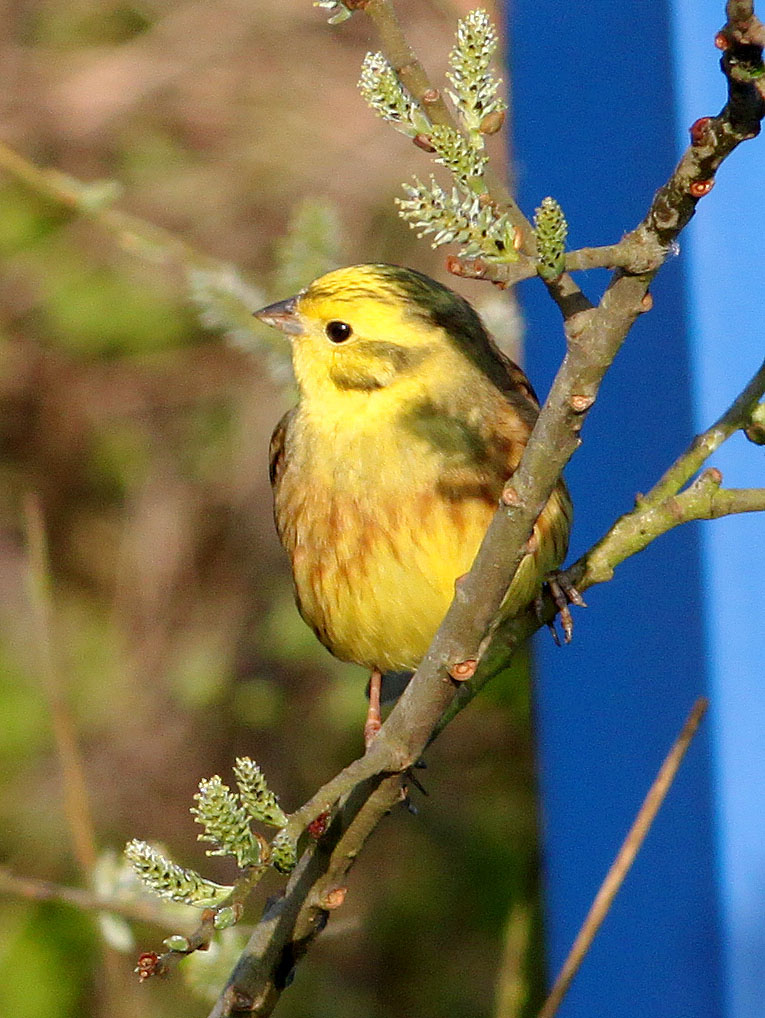
 Yellowhammer

Stoat

The BBC promised a change in wind direction overnight together with a less than 5mph wind, so the results tomorrow could be different again. And as we always remind ourselves “You don’t know until you try”. 


Related Posts with Thumbnails