Tuesday, March 15, 2022

Three Hour Slot

Bird ringers must grab every opportunity on offer in these windswept weeks even though such times may not be ideal. And so it was that we pencilled in Tuesday morning’s forecast of a three hour slot and a strengthening breeze as perhaps the only chance of the week. 

When soon after six I opened the house door to the morning air I was greeted by the unmistakeable staccato of a rare bird - a Song Thrush no less. 

It was too dark to photograph the thrush but I noted that it sang from the same part of hedge where a number of years ago a pair bred successfully. That must be eight or more seasons ago so while it’s very unlikely the thrush was a survivor of that brood, a bird of any species always picks their ideal habitat in which to set up home. Let’s hope he soon finds a mate and nests again in the hedge we share with a neighbour. 
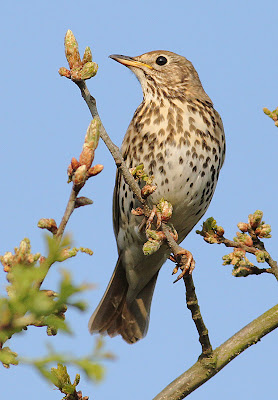
Song Thrush
 
Another rarity was soon to follow with a Grey Partridge very close to the entrance to our ringing site. I am fairly sure that in this area of Fylde, Lancashire the Grey Partridge is rarer than a Song Thrush. 

Grey Partridge
 
I met Andy at 0630 and nets were soon up to a 5mph southerly, so far so good. Even better were the first migrants of the year caught early on as a Chiffchaff and 2 Goldcrests, all three males out to stake their claim wherever they were headed. As early morning migrants all three tipped the scales at less than 6 grams. When later inputting details into DemOn, the system prompted a check of the Chiffchaff weight as below the species' expected range.

These birds were a great start to a morning, one that petered out when the wind increased to 10 and then 15mph.  At one point we could see a Grey Wagtail balanced on a branch directly next to a blowy net. There was no way the wagtail would be caught, even Grey Wagtails aren’t that dozy - 10 o’clock it was time to pack in. 

Chiffchaff
 
Reed Bunting
 
Goldcrest

All was not lost when upon neutralising the wind-socked nets a female Sparrowhawk decided to fly directly into the nearest one. Had we not been quick off the mark it would surely have escaped from the billowing mesh with a flap or two of its wings. 

The second year female could best be described as “feisty”, with legs and sharp talons lashing out at every opportunity. It was ringed and released pretty quickly but not before it had drawn blood from pierced fingers. 

Sparrowhawk talons 

Sparrowhawk

So ended an eventful if not very productive morning of just seven birds – 2 Goldcrest, 2 Reed Bunting, 1 Chaffinch, 1 Chiffchaff, 1 Sparrowhawk. 

Andy is off with Sandra to the winter sunshine of Egypt on Saturday and is keen to fit in more ringing on Friday. Pencilled in once again.  

Fingers crossed. We shall see. 

Linking today to Anni in Texas and Eileen's Saturday Blog.


Thursday, March 10, 2022

In Like A Lion

“Comes in like a Lion, goes out like a Lamb.” - attributed to Thomas Fuller’s 1732 compendium, “Wise Sentences and Witty Sayings”.

Thomas - I am not amused by your witty saying.  Another week of weather watching has seen a couple of pencilled in days scrubbed from the ringing diary as March roars like the proverbial Lion. Thursday was looking good, Thursday moved to Saturday and now that too looks unlikely. And there’s little sign of lambs gambolling in spring sunshine.

So friends, it’s back to the archives today with a few pictures of Bramblings and others from December 2012 when there was something of a “Brambling Winter” and our ringing group processed more than 70 Bramblings between September 2012 and April 2013.          

~~~~~~~~~~~~~~~~~~~~~~~~~~~~~~

Did last week’s blizzards in Eastern Europe, dubbed “The Beast From The East” cause Bramblings to head west? This morning I caught 4 new ones in the plantation at Out Rawcliffe, making nine this week. It’s not a huge number in the grand scale of the millions in which Bramblings can flock in Europe, but it could mean many more are heading this way soon. 

Bramblings can be overlooked in apparently single species flocks of very flighty Chaffinches, the Bramblings giving away their involvement by the slim, white rump. Very often a Brambling will give out a nasal contact call but sometimes not, when the unremarkable chattering flight call can be overlooked in the calls of accompanying Chaffinches.  Click on the "xeno canto" button to hear Brambling calls.

Brambling


I think the attraction at Rawcliffe is the nyger feeders and the small amount of mixed feed on the ground, a mixture which contains sunflower seed. During the last large influx of Bramblings in 2010/2011 many took to using garden feeders. As a species they were very dominant in the feeding hierarchy by chasing off most interlopers.

Brambling

Brambling 

It was a short session, a late start only when the sun warmed the air, followed by a hasty pack up when a strengthening easterly wind blew through leafless trees and billowed the nets. 

So, 4 Brambling, 4 Chaffinch and a Goldfinch with no recaptures of the Bramblings from Tuesday. 

Brambling

Brambling

The dullish female pictured above had very visible fault bars. 

Brambling - fault bars

There were a good number of birds to take note of this morning, with 2 Buzzard, 2 Kestrel and a Little Owl before I even reached the farm.  The owl had puffed up to keep warm air in those feathers. 

Little Owl

Buzzard

In between the bit of ringing I clocked up 1 Sparrowhawk, 2 Snipe, 35 Fieldfare, 22 Redwing, 32 Skylark, 15 Reed Bunting, 250+ Lapwing, 1500+ Woodpigeon, 1 Mistle Thrush and 2 Raven. 

Fieldfare

There’s more news from North, South, East and West pretty soon from Another Bird Blog, so log in soon to find out just where. 

~~~~~~~~~~~~~~~~~~~~~~

Fingers crossed that I get out soon. Maybe a Brambling or two from the supplementary food dropped at Cockerham.

Thursday 10 March 2022.

Linking at weekend to Eileen's Saturday Blog and Anni in Texas.


Saturday, March 5, 2022

March Mornings

So soon do March mornings need the alarm clock to cope with lighter mornings and earlier starts to catch those early rising birds. Saturday began with a 0615 alarm for the 0700 meet with Andy over Cockerham way. 

On Friday night https://www.windy.com predicted a 6mph from the north and they weren’t far off the mark as we set a couple of nets while allowing for wayward gusts that might snag nets on nearby hawthorns. At 1° it was to be a cold morning and a tad too breezy for a go at the open field Linnets. 

In the week I’d dropped seed in our main net ride to guarantee a few birds and suspected the usual species would conform but the catch was poor. Perhaps many birds have left for the north and not been replaced or maybe the weather played a part in our poor catch of just 7 birds - 2 Reed Bunting, 2 Robin, 2 Blackbird and 1 Blue Tit. Whatever the reason by 1000 we decided to abort the session and hope for a better day soon. 

Blackbird

Reed Bunting

Robin
 
Other birds seen – 120+ Linnet, 2 Skylark, 50+ Curlew, 17 Lapwing, 450 Pink-footed Goose, 4 Little Egret, 1 Sparrowhawk looking for careless Linnets. 

Sparrowhawk

Back soon. Don't go away.

Linking today to Eileen's Blogspot and Anni in Texas


Tuesday, March 1, 2022

Trying Linnets Again

The enforced three month absenteeism from our Cockerham ringing site was both worrying and frustrating, more so when thinking about information that was probably missed. 

Here below is an example, a Chaffinch ringed on one side of the divide on 10 November 2021 and then recaptured 25 February 2022. The record nicely illustrates how a common and seemingly unexciting Chaffinch can provide an interesting recovery. 

Adult male Chaffinch ALP8327 was captured, then ringed and released at Cockerham on 10 November 2021, one of three Chaffinches and 13 other birds caught that morning. The Chaffinch was recaptured by Borders Ringing Group at Garvald, a hamlet near Dewar in the Moorfoot Hills, Scottish Borders area of Scotland on 25 February 2022. 

Chaffinch - Cockerham to Dewar
 
Chaffinch - adult male

A glance at the direction of travel shows a direction of travel as due North at a time of year when wintering Chaffinches are known to migrate. 

~~~~~~~~~~~~~~~~~~~~~~~~~~~~~~~~~~~

On Tuesday morning Andy and I decided to try out our newly acquired ringing site at Warton near Preston where until recently there had been over 1000 Linnets, perhaps as many as 1500. So numerous were the Linnets that the farmer told us how on a dozen or more occasions the combined weight of so many Linnets (1000/1500 x 18 grams) had snapped the overhead wires above the set-aside field, lines that the Linnets used as a launch pad and resting spot. 

The farm is a dairy farm only where crops are not grown, so apart from Swallows, owls in the outbuildings and common hedgerow species like Wood Pigeon, Dunnock, Blackbird and Chaffinch, the bird life is run-of-the-mill. The fields of agri-environment provide more bird interest in autumn and winter, especially for ringers. 

Linnets

When we arrived about 0830 we counted more than 500 Linnets already on site. Unfortunately the Linnets did not perform as we hoped whereby we managed to catch the grand total of two. 

Linnet

It was the old story that we know only too well after five years of trying to catch a species that shares some human attributes of being shrewd, cautious, wily and wary when suspecting danger. 

There was a Kestrel that watched proceedings from atop the poles, together with a calling and circling Buzzard from nearby woods, but it seemed that the Linnets were more wary of two humans in their plot rather than winged predators. 

Kestrel

Just as the aforementioned Chaffinch on its way north, the Linnets too are daily reducing in numbers, and where by early April there will be a few pairs in the farm hedgerows once the winter flock has left for pastures new and north of here. 

The weather is due to turn wet windy again until perhaps Saturday. Stay tuned friends, there will be more news and views soon. 


Friday, February 25, 2022

Show Stealer

I kept the ringing pliers oiled and now at last, three months later, we reached the end of the Avian Flu tunnel. DEFRA/APHA revoked the lockdown on 20 February, an overdue move that allowed a resumption of bird ringing in no-go areas introduced on 26 November 2021. 

The whole week we itched to go ringing but constant winds wouldn’t allow. And then today when I went to drop supplementary seed the wind in the hedgerow ride seemed bearable and workable. I phoned Andy who didn’t need much persuasion to head over to Cockerham. 

By 1030 we had nets up and for the next few hours began to catch birds. The wind at 10-12 mph was too strong for catching any of the 150+ Linnets in an open field but in the more sheltered ride we caught 20 birds of other species. These were species I’d been seeing but unable to catch for more than 3 months - 7 Chaffinch, 4 Reed Bunting, 3 Blackbird, 5 Blue Tit and 1 Brambling. 

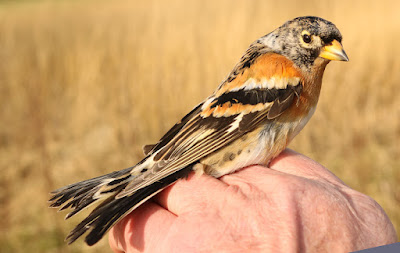
The Brambling stole the show, a highly colourful and obvious second year male. 

Brambling 

Brambling 

Bramblings have been scarce in the North West this winter, this particular one my second only in what has been a mild if wet and windy time. During February, March and April any Bramblings we see are likely to have come from further south and now migrating to breeding areas in the forests of Northern Europe and further east into Russia. 

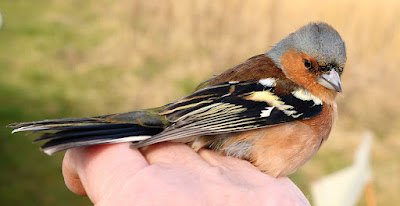
Chaffinch
 
Chaffinch

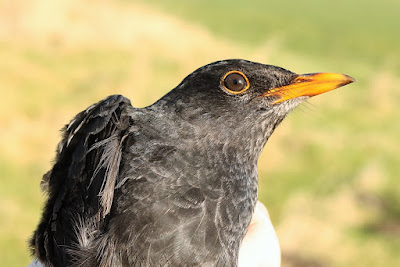
Two of the Blackbirds were of the “continental” type, second year males with typically pale scalloping on their breast feathers. 

Blackbird
 
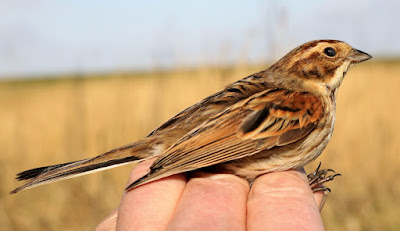
Reed Bunting

Reed Bunting

Other birds seen - Buzzard, Sparrowhawk, 4 Little Egret, 2 Skylark. 

It was good to get out today. Here’s hoping we have no more flockdowns that stop our vital work. 

More news, views and photos soon. 


Related Posts with Thumbnails