Friday, July 17, 2020

Too Good To Be True

After another week of rain and rubbish weather we hoped that today’s forecast of a decent morning would be accurate. 

On the drive towards Oakenclough a hint of sun broke the early clouds. At 0630 roadside trees hardly stirred. This was all too good to be true. And so it proved.  For the next four hours Andy and I dodged periodic drizzle and showers that blew in from the west until we packed in at 1030 when light rain turned to a heavy wetting shower. 

Had the sun stayed around longer we felt sure that our catch would have been higher as despite the cool showers and grey skies, there seemed to be good numbers of birds moving through the area. Between the drizzly showers came post-fledging parties of Nuthatch, Chaffinches, titmice and Swallows. One of these moments brought in a Hobby that gave a rapid fly past before heading south east and out of sight. A birder who lives not far away reports seeing a Hobby every day of the week. 

Given the stop-start nature of proceedings we were quite pleased to finish with 28 birds of 13 species – 24 juvenile birds of the year and 4 adults - 8 Willow Warbler, 3 Chaffinch, 3 Coal Tit, 2 Chiffchaff, 2 Blackcap, 2 Treecreeper, 2 Great Tit and singles of Goldfinch, Robin, Wren, Blue Tit, Goldcrest and Garden Warbler. 

Pictures below - all taken at ISO800/1600 in poor light yet again. Whatever happened to summer? 

Treecreeper 

Coal Tit 

Goldfinch 

Willow Warbler

Chiffchaff

Note how the outline shape of the Chiffchaff wing differs from the Willow Warbler. The Chiffchaff wing is shorter and rounder with primaries 3,4 and 5 of similar length. Primaries 3 and 4 of a Willow Warbler wing are longer than primary number 5.

The sixth primary feather of the Chiffchaff is partially emarginated whereas the equivalent feather of the Willow Warbler is not emarginated. 

Wing of Chiffchaff

 Wing of Willow Warbler

The differences are easier to see from the drawings in my 1984 dog-eared edition of "Svensson". But the facts remain the same in 2020.

Chiffchaff 
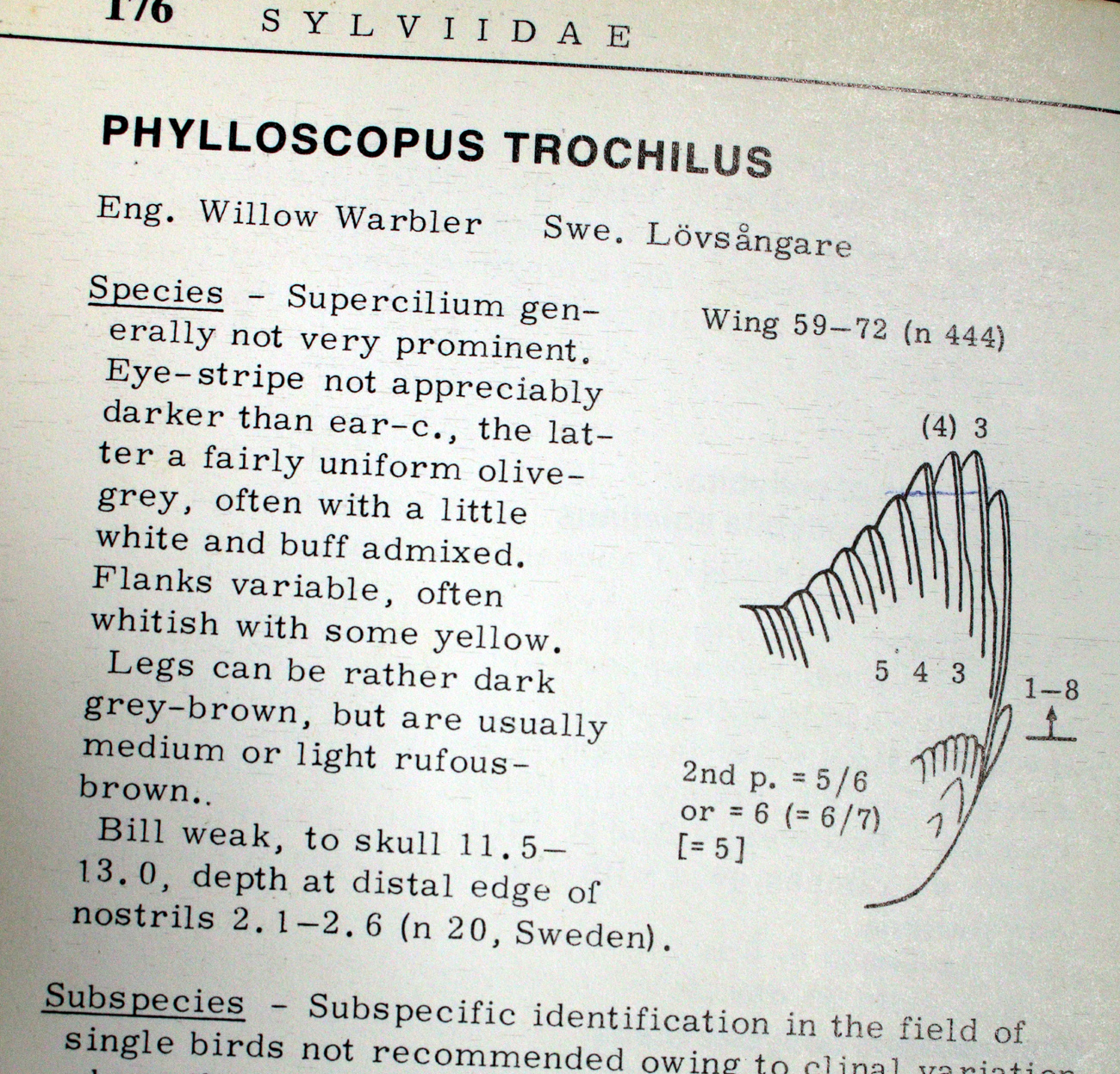
Willow Warbler

 More news and views soon from Another Bird Blog.

Linking today to Eileen's Blog and Anni's Blogspot.


Wednesday, July 8, 2020

Pied Surprise

It’s a week since my last posting. In between has seen rain, rain, then more rain, and no chance of birding, ringing or lifting a camera. Given all the foul weather I was not surprised by news from Chris at Cockerham where after two days of relentless wind and rain he found a dead Avocet youngster, one of the chicks ringed on 24th June

Avocet chick 

It appears that during the bad weather the adults moved the chicks from open water to a more sheltered part of the farm but at least one succumbed. Let’s hope there are no more fatalities. Fingers crossed too that the Avocets return here in 2021. 

Avocet 

On the strength of different forecasts Wednesday morning was pencilled in as a “maybe”, and Oakenclough as the venue. The previous visit of July 1st saw the first real hints of autumn migration. 

This morning I met up with Andy and Bryan at 0630 to a 15-20 mph easterly wind, far stronger than several forecasts that all suggested 6-8 mph. After each of us had driven 40 minutes or more we decided to continue in the less than ideal conditions in the hope the wind would drop. 

As the morning wore on the wind dropped slightly and allowed us a reasonable catch of 24 birds – 21 birds of the year and three adults: 5 Willow Warbler, 4 Great Tit, 3 Chiffchaff, 2 Blackcap, 2 Chaffinch, 2 Greenfinch, 2 Goldcrest, 1 Wren, 1 Dunnock, 1 Goldfinch, 1 Pied Flycatcher. 

Oakenclough springs a few surprises on most days. Our surprise today was the juvenile Pied Flycatcher. It’s a species we never catch in mist nets despite the fact that Andy rings many nestlings from boxes a quarter of a mile away. 

Pied Flycatchers are notorious for arriving unseen on their breeding sites and then leaving in autumn equally undetected. This one, AKE3941 was ringed at the nest box along with three siblings on 28 May 2020. 

Pied Flycatcher 

 Pied Flycatcher - juvenile/first summer

Greenfinch - juvenile/first summer

Chiffchaff - juvenile/first summer 

Willow Warbler - juvenile/first summer 

Strong early winds didn’t help our birding, a highlight being a passing Peregrine Falcon as it dive bombed a local Buzzard. Otherwise a few Swallows, a Great-spotted Woodpecker, Pied Wagtail and the arrival of autumnal Goldfinches around the feeders. 

Back soon. Don’t go away.

Linking today to Eileen's Saturday Blog and Anni's Blog.


Wednesday, July 1, 2020

The First Of July

Last weekend saw hints of an early irruption of both Siskins and Crossbills from their summer breeding haunts in Scandinavia. So far, the migration had occurred on the east coast, the part of England closest to Scandinavia. 

“24 June - After an amazing 327 Crossbills at Scarborough, South Cliff, Yorkshire yesterday (23 June) blown away by an incredible 610 Crossbills between 0430-0700 this morning together with a supporting cast of 601 Siskins” 

“25 June - Another day on Scarborough South Cliff dawns & incredibly, even more Crossbills on the move! Over 1200 flew south this morning (with 1100+ in first two hours)." 

Would the change to July bring some of these birds here to the west of the Pennine Hills that divide Yorkshire and Lancashire? As expected we’d had a couple of low number catches during June but with a definite autumnal feel to the week gone by we felt that July might bring change.

This morning I met Andy at Oakenclough to a dull, mizzly morning. Full of optimism and imaginings we added Crossbill to our autumnal bird callers and laid a tray of water in the net ride nearest the confer plantation. It’s said that because Crossbills feed mainly on dry conifer seeds, they are always thirsty and that a good supply of water is really important to their survival.

Gradually the mist and drizzle cleared before the sun finally arrived around eleven o’clock. Needless to say, we caught no Crossbills but we did enjoy an unseasonable adult male Siskin amongst our catch of 17 birds - 5 Willow Warbler, 4 Blackcap, 2 Robin, 2 Great Tit, 1 Blackbird, 1 Garden Warbler and 1 Siskin.

Apologies for the not so good pics today, most taken at ISO1600 in the drizzly light of 0630 to 1000 hours.

Siskin - adult male 

Willow Warbler - juvenile 

Garden Warbler - adult female 

Blackcap - adult female 

Meanwhile, the captions for Caption Contest continue to arrive for my last post of Friday 26th June. 

Kestrel chicks 

Thank you everyone for your topical, inventive and funny captions. And for those readers yet to enter the competition, it is not too late.

Read the captions so far and just enter your suggestion in the comments box of this or the last post of Another Bird Blog.

Back soon with more news and views. And ......................

Crossbill 

Crossbill

............... keep eyes and ears open for those Crossbills.  You just never know.

Linking today to Eileen's Saturday and Anni in Texas.


Friday, June 26, 2020

Caption Contest

I couldn’t make it on Thursday so Andy sent me a picture of three young Kestrels he ringed. It’s deserving of a funny caption. All entries to Comments section please. The winner will receive a copy of the photograph. 

Kestrels 

Friday morning, and prior to meeting Andy I had an hour spare for a look at Conder Pool. 

Late June and singles of both Greenshank and Common Sandpiper are back. There was an increase of Redshanks too with a count of 30+, with maybe a slight increase in Oystercatchers and Curlew in the creeks where 2 Avocet fed. On the water, 4 Shelduck, 6 Tufted Duck and 3 Canada Goose - of the latter, two adults and one gosling. The Canada Geese would seem to be the single wildfowl success this year with the winning waders a single pair of Oystercatchers; but even they reduced now to a single chick. 

Oystercatchers 

There may be an inquest into what has gone wrong with the breeding birds of Conder Pool in 2020. Animal predators like Mink and Fox, overgrazing of both cows and sheep, or human interference appear to be the favourites. My own observations suggest a mix of all three. 

While 2020 has been a disastrous year there remains too much focus and emphasis on the two recent colonising species, but there is memory failure, inexperience, and a lack of awareness of those species lost as breeding pairs in recent years. 

As might be expected nowadays, star billing is given to the ‘celebrity’ species of Common Tern and Avocet. Meanwhile the less glamorous but equally important ones like Lapwing, Little Ringed Plover, Little Grebe, Tufted Duck, Shelduck, and Redshank are shoved down the memory hole. 

With the right habitat suitably managed and protected from interference by man and/or predators, those lost species will surely return to breed at Conder Pool with the terns and avocets? 

There might be a few hours before rain would arrive where Andy and I might catch a few warblers and to update our farmer pal on his breeding birds. We ringed 3 Reed Warbler and 2 Sedge Warbler before ever darkening clouds rolled in from the west. 

Sedge Warbler

Sedge Warbler 

Reed Warbler

Birds seen, including the five ringed: 1 Blackcap, 2 Sedge Warbler, 8 Reed Warbler, 7 Reed Bunting 

Around the fields and the small pool - 2 Grey Heron, 2 Little Grebe, 3 Mute Swan, 4 Corn Bunting translated as 2 breeding pairs. 

Seven Reed Bunting, 400+ Starling, 65 Curlew, 12 Lapwing, 10 Oystercatcher, 4 Stock Dove 6 Woodpigeon, 12 Swallow and 1 Sparrowhawk. 

By ten o’clock the dark clouds turned to rain so we ran for cover.

Linking today to Eileen's Saturday Blog and Anni in Texas.


Wednesday, June 24, 2020

Martins and Hobby

It was 16 June, 8 days before, that we ringed four tiny Avocet chicks. When I telephoned Chris on Tuesday evening to say we’d be along on Wednesday to the Sand Martins he said that the Avocets still had four youngsters. That’s quite an achievement since many wading species that start off with four eggs followed by four chicks can quite easily find just a single one makes it to adulthood. 

The Avocets were close by again, near enough to rattle off a number of pictures before we set up the single net for the Sand Martins. It was quite difficult to get all four chicks together in one frame. 

Avocet chicks

Avocet 

Avocet 

Avocet 

Avocet 

Avocet 

We were joined today by Bryan, an extra pair of safe hands for the tricky job of erecting a net to catch the Sand Martins. Catching Sand Martins proved more successful than 8 days earlier as it became clear that more juveniles were around this week. 

Andy and Bryan 

Sand Martin - juvenile 

The martin nests are located at the end of long tunnels, which can be up to a 1m long into the gravelly sand. The chambers are a hotbed for parasites, mostly blood sucking hippoboscid, louse flies. Although not all chicks have the parasite, where we spot them and where possible, we remove the unsightly ticks by a light squeeze and twist of the tip of the ringing pliers. We then quickly send the chick on its way. 

Sand Martin with parasites 

Sand Martin - juvenile 

We caught 23 Sand Martins, 13 juveniles and 10 adults. A recapture ring number S348922 had been ringed here as a juvenile on 1st July 2017 but not in between those dates. 

We had finished ringing the last martin when we heard the distinctive calls of a Little Ringed Plover flying overhead as it continued in a southerly direction. ‘LRPs’ as they are known by birders have bred on this site. Not in recent years, but in conjunction with the farmer, we are working on the idea of increasing the site's species list.  

Over a nearby wood we saw a family party of 6 Kestrels in the air together, probably 4 young and both parents. It’s not a completely unknown sighting but rather welcome when it happens. 

Better was to come a minute or two later in the shape of a Hobby, the bird attracted into the area by the sight and sound of 140+ Sand Martins. It hung around for a minute or two before flying off south in the direction of Pilling. 

It was a fitting end on the high of a very enjoyable morning.


Related Posts with Thumbnails