Friday, October 25, 2019

British Birds: A Pocket Guide - Review

Back in 2016 I reviewed the WILDGuides Britain's Birds: An Identification Guide to the Birds of Britain and Ireland, at the time a new and entirely photographic guide to the birds of the UK. It received lots of plaudits and congratulatory reviews, including my own, and went on to become a best seller. Britains Birds Book Review.

At the time I made reference to the book’s bulk and weight as I considered that the proportions could result in the book being used as a reference book rather than a field guide. “….. Measures 6” by 8” and contains 3,300 colour photos within its 560 pages …. here was a hefty piece of work. It tipped the scales at 1200 grams, making it a candidate for inclusion in a large rucksack” 

That has all changed with the publication of the new WILDGuides British Birds: A Pocket Guide which as its title claims, is a field guide for the pocket rather than a rucksack. 


By the same authors, this is a slimmed down version of the original of 2016 now shrunk to a more manageable and user friendly 7” x 5 “. This mini version weighs in at a highly portable 400gms (14ozs). 

Whereas the original book covered all those species that have occurred in the UK (600 species) this latest book covers only the most regularly occurring species, 248 in all, plus 45 scarcer species. Amazingly, the new book still manages to include over 1,600 photos, all of which are of a very high quality indeed and where the reduction in size has not resulted in any lessening of definition. I did not check each photo against the earlier version but as you might expect, many if not most are replicas from the bigger volume.


The now condensed text is concise but thorough enough to help with identification. A Pocket Guide is well though out and structured to assist the reader.  The authors continue the essence of the first book and pack a huge amount of information in the pages without it being cluttered or overwhelming. 

By forfeiting the inclusion of the very rare species but including regular scarcities the authors have chosen their target audience well. 


This is a book that will appeal to beginners and to those with a modicum of interest in identifying birds who want to take their burgeoning awareness that little further. 

Priced at £9.99, this is another one of the top quality bargain books we have come to expect from Princeton's WILDGuides series. With Christmas around the corner this little book would make  a pleasing little gift for child or adult alike. 

Linking today to https://viewingnaturewitheileen.blogspot.com.


Wednesday, October 23, 2019

An Outstanding Event

This morning saw a heavy and highly visible migration of northern thrushes through our Oakenclough ringing site.  Andy, Bryan and I met at 0645 with nets up and set ready for 0715. 

We caught very few birds in the less than ideal conditions of a 12/14 mph southerly wind and bright sunshine on one net, but witnessed an impressive movement of Northern thrushes based almost entirely on North West to South East flight lines 

Our tally of ringing was just 12 birds - 9 Redwing, 1 Song Thrush, 1 Blackbird, 1 Robin. 

Redwing 

Song Thrush  

These nine birds were a tiny part only of a count from 0800 to 1100 that saw approximately 3800 thrushes - 2300 Fieldfares and 1500 Redwings. 

All was quiet until about 0800 when the influx of Redwings and Fieldfares began from the direction of the coast and Morecambe Bay some 15 miles away. It was slow at first, mainly Redwings then as the light and visibility improved we realised that a heavy movement was on the cards. So it began with flocks of anywhere between five, fifty and three hundred thrushes, mostly mixed. There was always a majority Fieldfare configuration, especially in the latter stages when good numbers arrived from a more northerly, even north easterly direction, flying quite low against the now fresh southerly wind. 

The plantation has a heavy and very brightly coloured crop of hawthorn and rowan berries that the thrushes targeted as soon as they landed. 

Redwing and Fieldfare

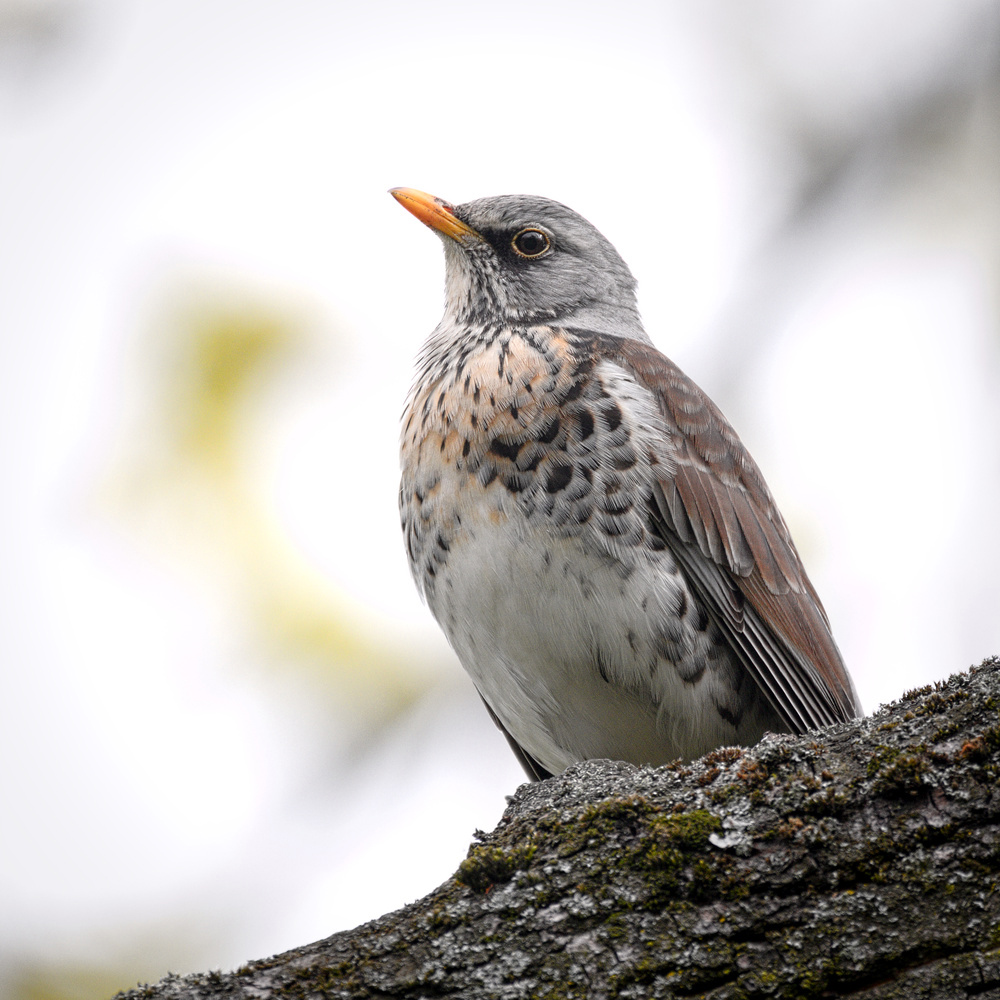
Fieldfare

Other birds were in the mix, one or two Song Thrush, Blackbird and Mistle Thrush but almost certainly more in the general melee of hundreds of overhead birds. Otherwise- 25+ Chaffinch, 30 Woodpigeon and one Sparrowhawk that hunted the arriving thrushes. 

A further sighting was of three Jays, an essentially sedentary species unless acorn crops fail, when they must migrate to other areas for food. Such years may result in quite large numbers of Jays being seen on visible migration. This may be the case this year with many reports of Jays in unusual and non-regular locations. 

Eurasian Jay 

In recent days I looked on local Whats App Birding and Bird News, Twitter and Facebook but found no messages, posts or apparent interest in this once in a year spectacle. It would appear that Redwings and Fieldfares are not rare or exciting enough to merit a mention. 

The absolute best local web and information site I know belongs to Bryan Yorke, who come rain or shine, conducts daily visible migration counts at Burton in Kendal,  Arnsideand Silverdale Blog , some 20 miles just north west of Okenclough.  His sightings and counts give a useful comparison to our own. Bryan's very low counts from today seem to point to this morning’s thrushes taking both more coastal and also inland Pennine routes. 

"Wednesday 23rd October 2019 Taylors Fields, Vicarage Lane, Burton In Kendal 0730hrs" 

"Obviously the thrushes were not about other than a sprinkling which seemed to be going in various directions."

"Chaffinch: 306 (282 SE and 14 W) 
Linnet: 216 (213 SE and 3 SW) 
Redpoll: 3 SE (one party) 
Greenfinch: 1 SE 
Alba Wagtail: 11 SE 
Skylark: 6 SE 
Fieldfare: 98 (20 W/SW,10E,4E,4E,6NW,9W,30SW,15N) 
Redwing: 171 (5SW,3SW,30SW,12SW,50SE,1E,6E,30SW,10SW,9S/SW,5SW,10SW) 
Starling: 50W (15,2,4,5,20,4) 
Woodpigeon: 29 NW 
Pink Footed Goose: 6 SE at 1135hrs" 

Back soon folks. Keep logging in for more news, views and photos.

Linking this post to Anni's Birding Blog.


Saturday, October 19, 2019

Chalk And Cheese

An extract from North Ronaldsay, Orkney Blog - 16th October 2019. 

“A fantastic day with birds everywhere, massive flocks of Thrushes moving across the island throughout the day; the huge rolling flocks of Redwings filling every field, coming in off the sea and dropping vertically out of the sky was something else! No real rarities were unearthed but it didn’t matter one jot with everyone just revelling in the spectacle unfolding in front of them; totals (largely underestimates) comprised 11 Herons, 3 Hen Harriers, 2 Merlin, 3 Jack Snipe, 283 Snipe, 13 Woodcock, 5 Short-eared Owls, 320 Robins, 2 Black Redstarts, 3 Redstarts, a Wheatear, 11 Ring Ouzels, 315 Blackbirds, 257 Fieldfare, 1,197 Song Thrush, 10,977 Redwing, 2 Mistle Thrushes. A brilliant day for the ringers with a total of 381 birds processed through the day”. 

Meanwhile on Saturday 19 October it was back to reality at Oakenclough where birding on North Ron’s scale is beyond our wildest dreams and ringing sessions mostly sedate. Chalk and Cheese spring to mind. 

I drove through patches of mist for our 0630 start. When I arrived fog enveloped the ringing station and stayed there for the first hour and more. Through the fog a few Redwings arrived and the first six birds to find the nets were Redwings. 

Slowly the rising sun burnt through the low cloud and by 0900 we were in bright sunshine. Visible migration today was stuttering with a piecemeal arrival of thrushes and finches until we packed in at 1120. 

Approximates - 125 Redwing, 40 Fieldfare, 10 Blackbird, 45 Chaffinch, 35 Goldfinch 20 Lesser Redpoll, 6 Greenfinch, 18 Woodpigeon. 32 Birds caught - 9 Goldfinch, 8 Lesser Redpoll, 6 Redwing 4 Chaffinch, 3 Coal Tit, 1 Blackbird, 1 Great Tit. 

Lesser Redpoll - adult male 

Lesser Redpoll - adult male 

Chaffinch - first year male 

Redwing 

Redwing 

Redwings are smaller than one might imagine, slighter than a Blackbird, slimmer than a Song Thrush and the perfect size to fit in the palm of the hand.  We fit a size "CC" ring on a Redwing and the larger "C" ring on a Blackbird. 

Although Oakenclough is woodland edge habitat we catch very few Blackbirds. The young male today was a first year bird and almost certainly a migrant rather than a local bird. 

Blackbird 

We received more information about a ringed Lesser Redpoll, ARC5449 caught here at Oakenclough on 14 October 2019. The latest news told us that it was first caught and ringed at Ramsley Reservoir, Derbyshire, UK on 14 December 2018. The quite late date in December suggests that this particular redpoll, an adult male, might be a fairly sedentary individual able to winter in more sheltered areas of Britain rather than a traveller to more distant shores. A ringing recovery like this often raises more questions than it answers. 

Lesser Redpoll - Ramsley Reservoir, Derbyshire to Oakenclough 

More news and pictures soon from Another Bird Blog.

Linking this post to Anni's Birding Blog.

Wednesday, October 16, 2019

More Thrush

The forecast for Tuesday morning was about as good as it gets just lately - a gentle breeze from the north with a fair amount of cloud that would slowly break. That was enough to motivate us to head for Oakenclough again where Andy and I met up at 0645. We were joined by Bryan with Barnaby the Labrador. 

“Slow but steady” was the name of the game, with more Redwings, a few Lesser Redpolls and a couple of “unpredicteds” seen but not caught. Our catch was 26 birds - 8 Redwing, 5 Blue Tit, 4 Lesser Redpoll, 3 Goldcrest, 2 Chaffinch, plus one each of Great Tit, Coal Tit and Robin. 

Redwings came in fits and starts of tiny flocks and a total throughout the morning of 80/100 individuals plus a handful of migrant thrushes - Blackbirds, 3 Mistle Thrush and 2 noisy Fieldfare, the latter our first sightings of this autumn.  The Redwings we see in October and November are pure migrants rather than winter visitors. This week has seen a sputtering start to this annual migration of northern thrushes whereby millions of Redwings and Fieldfares rush through Britain to then spend the winter in Iberia and/or France. 

Once into the New Year, it will be more difficult to see either species here in Lancashire with their journey back north in the spring undertaken rapidly, often under the cover of darkness. Of the eight Redwings, there was one adult, the remainder birds born this year. 

Redwing 

Fieldfare 

At this time of year most Lesser Redpolls we catch can be safely aged as first years, i.e. born in the current year. One of those caught this morning had almost no hint of colouration in its greyish plumage so must have been born very late in the year - probably a second or even third brood? 

Lesser Redpoll - first year 

Lesser Redpoll - first year

Surprises came first in the shape and sound of an overflying Ring-necked Parakeet. Andy saw one (or the same individual) here about a week ago. The Ring-necked Parakeet is the UK’s only naturalised parrot with a wild population estimated at about 10,000/15,000 pairs. Thankfully the population is centred mainly round the south-east of England. The cold winters of northern Britain may have worked in our favour to stop the further expansion of a species widely considered to be a pest. 

A couple of bright intervals half way through the morning saw a flurry of Swallows heading determinedly south directly overhead. We saw a two, five and then a bigger group of eight. While mid-October is fairly late for migrating Swallows, this is certainly not without precedent, especially during mild and wet autumns. 

During the morning we also noted two large flocks of Pink-footed Geese, 400 + in total, coming off distant Morecambe Bay and then flying south, perhaps towards the goose fields of South Lancashire. 

Otherwise birds - 2 Great-spotted Woodpecker, 2 Sparrowhawk, 40+ Chaffinch, 8 Goldfinch, 2 Pied Wagtail.

Linking today to Eileen's Saturday


Saturday, October 12, 2019

Back Into Action

Saturday 12 0ctober. I gave my ringing pliers a squirt of WD40. What with the trip to Greece and then the bad weather, they’d been deprived of action since 8 September. 

This morning it was back to Oakenclough hoping to see and to catch some autumn migrants. While I was away in Greece Andy had good success here with 126 captures including 55 Meadow Pipits, 31 Goldcrests, 9 Chiffchaffs and a single but late Tree Pipit. 

He caught just three Lesser Redpoll at a time of year when the species should pile through in good numbers. At this time of year it is usual to think about the “good” species but also vital to consider any that are absent,species that appear in lesser numbers than usual, and most certainly, any that are absent.   

We met up at 0645 to zero wind and 50% cloud-cover and hoped for an interesting morning ahead. Given the time of year and following several previous days of poor weather it might be fair to expect a generous helping of birds. It wasn’t to be with a disappointing catch of 13 birds for four hours work – 3 Redwing, 3 Bullfinch, 2 Goldcrest, 2 Blue Tit and one each of Song Thrush, Reed Bunting and Chaffinch. 

We saw our first Redwings of the autumn when small groups arrived soon after dawn and throughout most of the morning – in all about 70/80 individuals. The Song Thrush caught was associated with these arrivals. We catch few Song Thrushes here and the ones that we do are 99% autumn birds. 

Redwing 

Redwing

Song Thrush

It was good to catch three more Bullfinch, two first year females and a first year male. That’s eight this year to date. Fingers crossed that this species can re-establish itself in the now re-energised plantation. 

Bullfinch - 1st year male  

Bullfinch - 1st year male 

Bullfinch - 1st year female

The Reed Bunting we caught was a first year male. 

Reed Bunting 

At about 1030 a heavy shower with hailstones brought an early end to our session. 

A squally shower 

Other birds seen – Tawny Owl, Sparrowhawk, 2 Pied Wagtail and 2 late Swallows.

Linking this post to Anni's Birding Blog.


Related Posts with Thumbnails