Saturday, July 14, 2018

Three Of A Kind

We had a drop of rain on Friday; the first here for several weeks, just a few showers that barely wet our parched, straw coloured lawn and briefly dampened the roof tiles. By Saturday morning we were back to sun and blue skies but I rather hoped that the scattered showers had produced a different bird or two as the birding of late has been rather predictable.

So I hit Micawber Road at the usual unearthly hour in the hope that something might turn up.  Naturally I headed for Conder Green, one of the most productive of local birding sites and where a couple of extra places are but a stone’s throw away to make for an often satisfying circuit.

It was good to see up to 20 Swifts hawking insects over the surrounding hedgerows this morning. That’s probably as good a count as anyone has had this year.

July sees the first Kingfishers returning to the pool. They breed close by along the canal or the associated River Conder. “River” is something of a misnomer since the waterway resembles the final throes of a babbling brook rather than a mighty river. I was more than pleased to see three Kingfishers today, a family group that stuck close together but stayed distant from the camera. Sorry for the poor images. Today wasn't the most productive in the picture stakes but you get the idea.

Kingfisher 

Kingfisher 

Kingfisher and Common Tern

Kingfishers

Like many other species, Kingfisher families stay together for a week or two after the youngsters fledge so that the inexperienced birds learn from the parents about growing up and how, where & when to feed. It’s rather like a human family except that kids and teenagers are very slow to learn, always think they know best, and if they ever leave home will likely be back.

The single pair of Avocets still have three good sized chicks ably looked after by their aggressive parents. In turn I watched both adults chase off a Grey Heron, a Little Egret and any number of Redshanks and Oystercatchers.

Avocet 

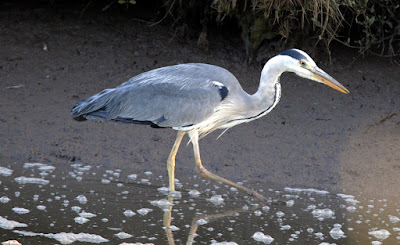
Grey Heron 

Other waders noted as 120 Redshank, 18 Oystercatcher, 15 Lapwing, 4 Common Sandpiper, 4 Curlew, 2 Snipe, 2 Greenshank. Smaller stuff – 6 Pied Wagtail, 2 Blackcap, 2 Reed Bunting, 2 Whitethroat and 2 Reed Warbler.

Greenshank 

Pied Wagtail 

Six Common Terns still around as they vied with the Kingfishers for the prime launch pad into the water below. Three Little Grebes on the water and now just 8 Tufted Duck and another mostly unproductive year for the persistent tufties.

Common Tern

There's still a pair of Common Terns hanging around Glasson Dock and here’s where I found a flock of 18/20 Goldfinches and a healthy number of House Martin nests right in the village centre. The martins fly down towards the dock gates for their building materials and where the tidal flow leaves exposed mud in this driest of summers.
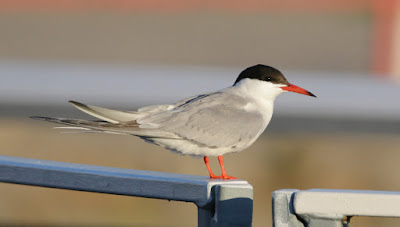
Common Tern

House Martin

I called into Gulf Lane where a small party of 6/8 Linnets plus 2 Whitethroats suggested it will soon be time to cut that ride for project Linnet.

That’s for another, cooler day.

Linking today to World Bird Wednesday and Anni's Birding Blog.

Dove Tales

I found an interesting piece on-line about the work of scientists at Lincoln University UK. It concerns the Turtle Dove, another rapidly declining bird of British farmland. The Turtle Dove is without doubt the most beautiful of the UK family of wild doves and pigeons. 

Turtle Dove  

Turtle Doves are pretty rare on the west coast where I live but they cling on in southern and eastern parts of the UK. Many years ago I used to see lots of Turtle Doves on family drives to the east coast of the UK when groups of the doves would scatter at sight of an approaching car. Like those other members of the pigeon family, Collared Dove, Stock Dove and Woodpigeon, the Turtle Dove is not averse to early morning feeds along the carriageways of major roads where they find grit essential to grind up their diet of grain. I believe that those self-same roads of Middle England and Yorkshire no longer produce anything like the number of Turtle Dove sightings due to the species’ decline. 

I see lots of Turtle Doves each year when we holiday in Menorca where they are still fairly common, but even here I have seen a decline in 15 years of visiting the island. It’s no secret that many, many thousands of migrating Turtle Doves are shot in the Mediterranean area each year, the main culprit being the island of Malta where at least 10,000 Turtle Doves were shot during 2015. 

Turtle Dove 

“New research into Britain's fastest declining bird species has found that young Turtle Doves raised on a diet of seeds foraged from non-cultivated arable plants rather than foods provided in people’s gardens are more likely to survive after fledging. 

Ecologists at the University of Lincoln investigated the dietary habits of adult and nestling European Turtle Dove -- a IUCN Red List Threatened Species -- breeding in the UK, using DNA analysis of faecal samples. They found significant associations between the body condition and the diet of the bird. 

Nestling Turtle Doves still being fed by their parents were found to thrive on seeds foraged from non-cultivated arable plants such as scarlet pimpernel and chickweed, but the birds were in poorer condition when their diet was high in seeds provided by humans in back gardens or public spaces. In contrast, adult body condition was better when more cultivated seeds such as wheat, oil seed rape and barley were present in the diet. 

Data collected for the study, which was carried out in collaboration with the Royal Society for the Protection of Birds (RSPB), the University of Sheffield and Cardiff University, was compared with the results of previous studies carried out in the 1960s and 1990s. It revealed a fundamental shift in the diet of Turtle Doves, showing that the birds are now relying more heavily on food found in gardens, such as sunflower and niger seeds, than they did 50 years ago. 

As the UK's fastest declining bird species, the results of the study have important implications for conservation strategies to save the Turtle Dove. Previous research has shown that nestling birds with better body condition are more likely to survive after fledging and strategies should be developed to provide the correct diet for the bird at each stage of its life. 

Turtle Dove 

Dr Jenny Dunn, Lecturer in Animal Health and Disease in the University of Lincoln's School of Life Sciences, led the research. She said: "Turtle Doves are the UK's fastest declining bird, with a loss of 98% of breeding birds since 1970. Researchers are trying to tackle the problem by identifying ways to provide food resources for the species while they are breeding in the UK, but for this to be effective we need to understand the birds' food sources and the impact they have on both adults and their young. 

"The results of this study suggest that conservation strategies should include provision of anthropogenic seeds for adults early in the breeding season, coupled with habitat rich in accessible seeds from arable plants once chicks have hatched." 

To understand the diet of the birds, researchers caught Turtle Doves on breeding grounds at 11 sites across East Anglia, and extracted DNA from the faecal samples which enabled them to identify the diet of each bird. Their body condition was also examined, and nest sites monitored. Further research is now needed to link the findings of the study to the use of habitats provided for Turtle Doves through agri-environment schemes.” 

Turtle Dove 

Thanks go to University of Lincoln. "Garden seed diet for threatened turtle doves has negative impact."  Science Daily  June 2018

This research may have implications for other species that regularly feed in gardens on supplementary food.  I guess the moral of the story is that when using additional feed systems in our gardens we should aim to provide food that is as near to a birds natural diet as possible.  Don’t feed on the cheap, and always buy the best you can afford.

Linking today to Eileen's Blog.

Friday, July 6, 2018

Making Hay

Thursday. Sitting in the shade of the old apple tree with a cup of PG Tips while reading more of Unnatural Selection felt like a good plan.

But then the dawn of yet another sunny day set me off on a trip over the meandering lanes of Stalmine moss. Eight weeks of this fine weather means we’ll pay big time when it finally breaks but in the meantime it’s “make hay” for birders and sun-worshippers alike.

Stalmine, Fylde 

There’s been a Corn Bunting or two singing of late but no firm evidence of breeding intent, and I know from experience the Corn Bunting is very secretive when it comes to giving away their ground nest hidden in an expanse of monoculture. A needle in a haystack has nothing on a Corn Bunting nest. But, there was a bunting singing from directly above the road only 40 yards away from the regular song post; if it’s the same male of course!

Corn Bunting 

Another car came along and then as it whizzed by, the bunting flew off. So yet again there’s real no evidence that this species has bred in our area or that it ever will again.

I’d briefly seen a Little Owl a few days ago in a location new to me. Early July and Little Owls have all finished breeding now so I reckoned this was a young one that might let me take a little look. As it shuffled along the ledge of the broken down shed it wasn't for letting me too close but made a mental note for year listing. Not.

Little Owl 

 During the winter most birders, including me complained that Conder Pool was too full of water, overflowing almost. Well now there’s very little and a fair bit of green algae on the surface but it looks ideal for a wader or two. Good shout as I spotted a single Snipe patrolling the muddy margin and then two black-bellied Dunlin.

Dunlin 

Oystercatchers were busy with their usual piping and running along the margins plus several Redshanks. But they all know to stay away from the mud nearest the public viewing spot, except any little ones that can’t yet fly and/or choose to hide away from the hot sun.

Oystercatcher with chick 

Otherwise things: dozens of Redshank, 2 Greenshank, 2 Common Sandpiper, 2 Little Egret, 1 Grey Heron, 14 Tufted Duck, 3 Little Grebe, 12 Lapwing, 2 Curlew and 2 Teal, the latter the first of the “autumn” arrivals. And there were the usual Common Terns but no Avocet today.

Sedge Warblers got off to a slow with reduced numbers start this year but I've seen and heard half-a-dozen of them on every look around Moss Lane, Jeremy Lane and up to Cockersands.

It was the same today with both Whitethroat and Reed Bunting on view but very quiet and unobtrusive. My theory is that the reduced numbers of singing males results in wider territories than normal years  with less need to sing.  That’s my notion so shoot me down in flames if necessary.  It’s not quite the same with Reed Warblers which do seem to be in small numbers even now – just two singing males at Conder Green but none along the reed fringed lanes. We can but hope that the record breaking weather of 2018 allows birds to produce lots of youngsters.

Sedge Warbler 

Sedge Warbler

Reed Bunting 

That male Reed Bunting is already showing signs of post-breeding moult, black head losing colour, wear on feather tracts and tail. I wonder where it’s been to get that ring on the right leg? It may have come from our own ringing at Glasson, half a mile away last winter.

That’s all for now folks. I'm off to sit in the sun for a while.

Linking today to Anni's Birding Blog and Eileen's Saturday Blog.


Wednesday, July 4, 2018

Unnatural Selection by Katrina van Grouw. A Book Review.

I came across Katrina van Grouw’s work as an author in 2012 when I reviewed her first book The Unfeathered Bird here on the blog. The book was somewhat unique, a seamless marriage of instructive art and natural science which portrayed Katrina’s talent as a self-taught scientist and a gifted illustrator of animals. That first book was an impressive and quite remarkable début. 

And now I have a copy of Katrina’s second book for review. It is even more outstanding and stimulating than the first; a brilliant concept that is quite stunning in its presentation and execution. 

Unnatural Selection -  Princeton University Press

Unnatural Selection is a celebration of the work of Charles Darwin and the 150th anniversary of Darwin’s classic work The Variation of Animals and Plants under Domestication (1868). Darwin’s most famous work is of course The Origin of Species (1859). Whilst formulating this theory of evolution Darwin’s years of research included extensive experiments in the selective breeding of plants and animals. He found evidence that species were not fixed and his investigations led to many detailed ideas which refined and substantiated his then revolutionary ideas about the origin of life on Earth.

The cover illustration and inside double page spread of Unnatural Selection “The Ascent of Mallard” (shown above) neatly hints how evolution is discussed in the ensuing pages. The drawing portrays how with gradual artificial selection, the common or garden Mallard Anas platyrhynchos became the Indian Runner Duck Anas platyrhybcchos domesticus – evolution intensified by the hand of  man

Katrina reminds us early on of her wish to weave art and science into the narrative, that the two subjects are not mutually exclusive and in tandem can prove exhilarating and intellectually stimulating. “…evolution… the most profound and exciting field in all biology. Art and science are not at opposite poles…….pursuing both needn't be a compromise. Pity the dry scientist or the airy-fairy artist with their narrow perception of the world. Together art and science add up to a richness and depth that far exceeds the sum of their parts." 

The book comprises 4 Parts - Origin, Inheritance, Variation, and Selection. Within those parts are 12 Chapters of crisp but detailed explanation that build on the analogy that Darwin himself used by comparing the selective breeding process (as opposed to simple domestication) with natural selection in the wild. Katrina’s background in natural history gives her a clear appreciation of both wild and domestic animals, their anatomy and variation. She has numerous accounts and stories behind them and recognises their significance for the understanding of evolution.

She features a multitude of examples of familiar selective breeding that go largely unrecognised as a form of evolution e.g. - dogs, cats, geese, ducks, canaries, finches, budgerigars, wildfowl and pigeons. A perfect example is familiar but perhaps not realised by all - the wild Rock Dove, Columba livia, the ancestor of domesticated, feral and racing pigeon.

Dogs - all descended from the Grey wolf. - Unnatural Selection

Katrina’s writing is full of passion and excitement for her subject. It is also intelligent, fluid, witty and easily read & understood, even for someone unscientific like me.

Here’s one tale from the many pages of her vivid writing: Chapter Four, Coloured Liquid; Coloured Glass. “One winter’s afternoon¸ I could have been seen fighting my way through a snowy squall across a desolate expanse of common land in north-east England leading a nanny goat on a length of rope. I was looking for a billy goat. My goat, Alice, was on heat, and as she was destined to be a milker, she had first to conceive. Goats don’t remain in heat for very long, so, regardless of the inclement weather I was forced to answer the need for immediate sex. There were usually animals tethered out on the common and, as I hadn't the slightest intention of paying for the service, it was a case of seizing an opportunistic union when no one was looking. Alice was a strapping beast, of no particular breed, but quite the tallest goat I've ever seen. However, the only male I could find that day was a tiny pygmy goat that could have easily walked between Alice’s legs without touching her belly. Undeterred, I untied the little chap and led both animals to a steeply sloping bank where I re-tethered the male at the top and Alice at the bottom, thereby compensating for his vertical challenges at least. Five months later she gave birth to two normal-sized kids, each barely smaller at birth to their pygmy goat father.”

The chapters are liberally dotted with fine illustrations that relate directly to the examples she describes. These splendid, sometimes full, or even double page drawings, are without exception simply magical, so delightful and brilliant that if anything, the reader is drawn to study them in such a way and for so long as to neglect the text and then lose the thread of the discussion.

There are 400 illustrations in the book. I use the word “illustrations” advisedly as this is the term given by the publisher. I rather think that many of the superb illustrations are works of art in their own right, up there with the very best of wildlife fine art. One of my favourites is her study of geese - simply superb.

Goose Ancestry - Unnatural Selection

In the Preface the author relates how in a previous life her application to study Zoology at Oxford University was rejected. Oxford’s loss is our gain so Kudos to Princeton University Press and their realisation that Katrina van Grouw has a unique talent; full marks to them for helping her to follow this now chosen path and to produce such an outstanding book. Unnatural Selection is so special and so brilliant in every way that I would not be surprised if it soon carries off a major prize of the book world.

Just lately I donated my copy of The Unfeathered Bird to a local school of 11-15 year olds in the hope that it might inspire one to follow such an interest or a career in either subject.  Eventually I will do the same with Unnatural Selection but for now I will read the book cover to cover and savour each page.

Pigeon Tails - Unnatural Selection

I highly recommend Unnatural Selection for lay readers as well as the more experienced natural history buff or biology student.  It is highly suitable for students of art, in particular those looking to follow a career in natural history illustration. It goes without saying that Unnatural Selection conforms to the very high standards of format, presentation and finish that we expect from Princeton University Press.

Dear Reader. You can own this extraordinary book for just $45 or £35 at Princeton Press.

There are more sample pages from the book at Amazon Kindle.


Tuesday, July 3, 2018

Another Bag Of Smarties

Tuesday morning 0630. I met up with Andy at Cockerham quarry where we hoped to catch up with Sand Martins (Smarties). It had been too long since the last visit but an unavoidable break in our plans - Last time.

On that occasion we caught 63 new Sand Martins, all of them adults, late May being too early for any young martins to be around. We did slightly better this morning by way of 67 Sand Martins, 57 of them new to us plus 8 recaptures from earlier this year and 2 from 2017. 

Of the 57 new, 40 proved to be adults, split 50/50 male/female together with 17 fresh juveniles. The colony seemed to be well on with their second brood, some females in the throes of egg laying. 

Sand Martin - juvenile 

Sand Martin - adult 

We’d finished our work by 9 o'clock so I went up to Glasson and Conder for a quick check. Fresh arrivals at Conder Green were a party of 4 Avocets, more Little Egrets than of late (6) and also 2 Greenshank. There are still 180+ Redshank. The four Avocets spent ten or fifteen minutes making a lot of noise before they flew off west, leaving the summering singleton but territorial Avocet behind. 

Little Egret

A single pair of Common Terns continues to feed young, 2 chicks on the pontoon, one on the island.  

Meanwhile I up at Glasson Dock I found the pair of terns, the ones that bred successfully very close by. 

Common Tern 

Common Tern 

Common Tern 

That all for today folks. Don’t forget,  tomorrow’s post will see a review of Unnatural Selection.

Linking today with World Bird Wednesday


Related Posts with Thumbnails