Showing posts with label Phil Slade. Show all posts

Friday, November 7, 2025

Bird Photographer of the Year, Collection 10

Another year goes by. It seems just yesterday that I reviewed Bird Photographer of the Year, Collection 9. And now, if a little late following the first package going missing in the post, Collection 10 arrives via a knock at the door from Parcel Force. 

Princeton’s Bird Photographer of the Year, Collection 10 celebrates bird photography from around the world, and as the sub-title explains this is the tenth iteration via a large format “coffee table” book of 11×9 inches. This is a perfect size with which to grab a cup of coffee, fully open said book onto a knee-height table and to then absorb the 250 or so fabulous photos. 


Opening the early pages reveals the categories of winning entries together with the “special awards”, a list that follows a helpful, logical order enabling a reader to quickly locate their own specialism. In the case of myself, all of the categories apply except perhaps the concept of Creative Perspective, but one ideal for photographers of an artistic intent. 

Working slowly through the pages a reader will find close to each entry the photographer’s words around the how, the where and the when of the shutter clicks that captured their winning shot. These notes and explanations of the occasion of the photo detail a wealth of technological data for camera enthusiasts, amateur and professionals alike. Here is information about the camera make, the lens, shutter speeds, the aperture and the relative ISO for readers seeking to emulate or better the winning shot. It's a learning curve for sure in allowing us all to perhaps experiment a little more with our accustomed dial settings.


Almost without exception the pictures come from the leading makes of Canon, Sony, Nikon in either DSLR or mirrorless form with just the occasional Olympus. If only it was so simple because despite the technical data, these stunning pictures in isolation cannot explain a winning photographer’s vital skills in field craft, experience, empathy and the lying in wait in often inclement weather. And of course a photographer's knowledge of how birds behave under many different circumstances of the season, time of day, weather and external influences. 

An encounter with a bird or birds is impermanent, a one off, never to be repeated again, hence why, and to the annoyance of some, a photographer’s need to keep the button pressed until the buffer is full to bursting. Everyone is after that world beating picture as displayed in Collection 10. However those setting out in pursuit of birds with slightly less costly equipment should not be discouraged but instead take heart and advice from the stories here that luck, perseverance, timing and field craft are vital elements in taking that special picture.  

Northern Harrier and Grey-headed Fish Eagle - Princeton

As I penned these words while recalling my favourite pictures from Collection 10, I ran out of superlatives. In no particular order - breathtaking, captivating, exceptional, extraordinary, fantastic, phenomenal, stunning, striking, unique, evocative, impressive, mesmerising, timeless. 

Anhinga in Florida - Princeton

There is an overall victor of BPOTY with both winners and runner ups in all of the categories listed in the opening pages. Meanwhile the link to Princeton's page about the book  - Princeton does not feature many of the winning pictures, and where in my opinion, those featured are not the best of the fabulous 250 pictures described here. 

Princeton are right to expect that people buy and enjoy the whole book of 250 images with their corresponding and instructive information rather than a cursory scan of half a dozen images on a PC or mobile phone. However, for those yet to decide whether to spend £35 on this book it’s possible to view a better selection of the category winners at https://www.birdpoty.com/2025-winners.   

I interspersed the review with a few of my own favourites, however a reproduced image via a computer screen is not the ideal way to judge this book. Despite the drains and demands on all of our finances in these difficult times £35 is a relatively small sum of money to own a copy for future reference and/or to revisit on many a dark winter’s day. 


And as we approach the Chrismas festival of late December, other than the latest bells and whistles camera and lens that could cost £10,000 - £15, 000, what better gift could there be for the birdwatcher in your life than this splendid book?

Price: $39.95/£35.00 
ISBN: 9780691278674  
Published: Sep 30, 2025 
Pages: 256 
Size: 11.25 x 9 in. 
245 colour photos.

PS. To all my friends who enquired after my well being. Thank you so much. Yes, I am well but taking a lengthy break from blogging. Maybe I will return soon with more news and pictures.


Thursday, March 30, 2017

Britain’s Mammals - A Review

On my desk for review today is a new Princeton field guide, a book which doesn’t feature birds but one that will be sought after by almost 100% of bird watchers. The book is the much awaited Britain's Mammals: A Field Guide to the Mammals of Britain and Ireland from Princeton Press. This is the latest in the series of best-selling WILDGuides. 

The authors of Britain’s Mammals are Dominic Couzens, Andy Swash, Robert Still, & Jon Dunn. Andy Swash and Robert Still were two of the authors of the hugely successful “Britain’s Birds”, first published in late 2016, a book which found its way into many a birders' library. This latest book is a companion to the bird guide and shares not only one of the authors, but also looks and feels the same as soon as the first page is turned. 

Britain's Mammals

Skipping introductory pages to books is a bad habit of mine, but on this occasion I found myself immersed in the Introduction to Britain’s Mammals. It really is essential reading by firstly reminding us that in comparison to birding, mammal watching is a minority interest with much to be discovered by those willing to devote time and energy. 

The Introduction explains in just a few succinct pages the life-cycle and biology of mammals together with a very useful explanation and diagrammatic display of the names and scientific classification of Mammalia. A handy text and photographic overview of the types of British mammals reminds the reader that in comparison to the comparatively easy pursuit of birding, the study of mammals requires different techniques. A potential mammal watcher must exploit various times of both day and night and often use different equipment and methods to find and photograph their elusive quarry. 

Britain's Mammals - Princeton Press.

Part of the Introduction, the History of Britain’s Mammals, describes how getting close to wild animals takes a great deal of concentration and patience to achieve any sort of result; watching mammals is infinitely more difficult than birding. There is a timely explanation of why. For seven centuries or more persecution and exploitation of both land and marine mammals was rife, with many species becoming extinct or their numbers seriously reduced. No wonder then that history has taught mammals how to avoid homo sapiens, their most deadly and persistent predator. 

I guess I suffer from many misconceptions about British mammals, the main one, borne out by a glance at the book’s Contents page, is just how many mammal species can be seen in the British Isles. It is easy to forget that the UK and Ireland terrestrial mammals like squirrels, voles, mice shrews, moles, hedgehogs, rabbit, hares, carnivores and deer are in the minority. Bats and marine mammals form the largest groups of British mammals, reflected in the 70 pages devoted to 30 species of bats and over 40 pages featuring 37 species of marine mammals – seals and cetaceans. 

Britain's Mammals - Princeton Press.

The field guide element of Britain’s Mammals has handy and up-to-date distribution maps on the species' page together with illustrations which denote both the status and size of the animal. A typical page contains tips and information on where to look for a particular animal, its habitat, habits, food, breeding behaviour and population status. Very often there is information and helpful advice on the tracks and signs that may give away the animal’s location and/or its identification.

There are seven pages devoted to illustrating animal tracks. The publishers even provides a ruler in the inside book cover for the reader to measure tracks they find and then compare with scale bars depicted at the illustrations on each relevant page at p46-52. What a simple but innovative idea from the authors to make this a fully interactive field guide. 

Britain's Mammals - Princeton Press.

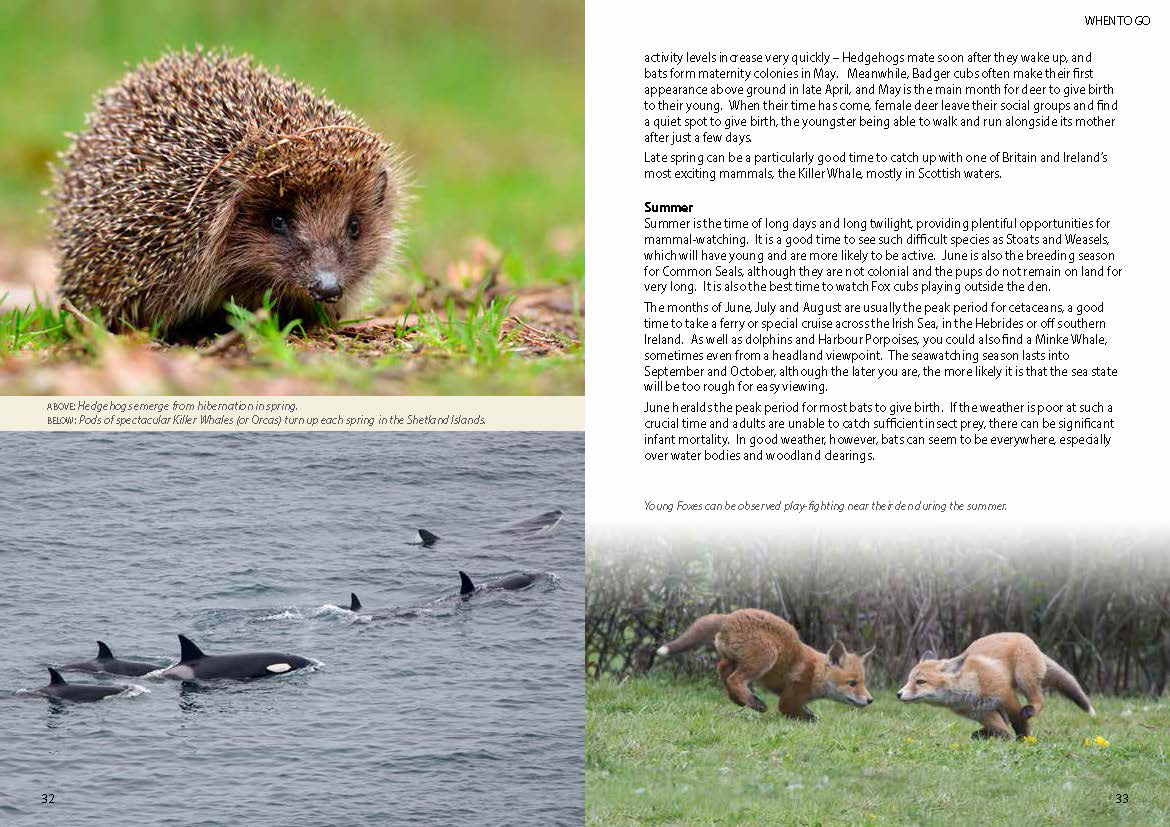
I must make special mention of the photographs in Britain’s Mammals. They are almost without exception truly stunning given the difficulties of in the first place even seeing mammals in the British countryside. In particular, the photographs of bats, both in flight and at rest, are simply superb, as are the pictures of mice and shrews. These are animals which are rarely glimpsed by everyday field workers who spend many hours in the great outdoors. I can only marvel at the time, skill, effort and dedication devoted to taking these images. 

Britain's Mammals - Princeton Press.

In summary. The winning WILDGuide formula continues throughout this wide-ranging and attractively designed field guide that follows in the major footsteps of Britain’s Birds. There’s a fully photographic experience and high quality information from its approximately 500 colour photos and 325 pages. 

Britain’s Mammals is a book for simple enjoyment as well as for learning and I heartily recommend it to readers of Another Bird Blog. It is available now from the usual sources at $29.95 or £17.95 and is something of a bargain. 

Britain's Mammals and Britain's Birds - Princeton Press.

Log in to Another Bird Blog soon for more news, views and reviews.

Linkintg today to Eileen's Saturday Blog.


Related Posts with Thumbnails