Friday, November 7, 2025

Bird Photographer of the Year, Collection 10

Another year goes by. It seems just yesterday that I reviewed Bird Photographer of the Year, Collection 9. And now, if a little late following the first package going missing in the post, Collection 10 arrives via a knock at the door from Parcel Force. 

Princeton’s Bird Photographer of the Year, Collection 10 celebrates bird photography from around the world, and as the sub-title explains this is the tenth iteration via a large format “coffee table” book of 11×9 inches. This is a perfect size with which to grab a cup of coffee, fully open said book onto a knee-height table and to then absorb the 250 or so fabulous photos. 


Opening the early pages reveals the categories of winning entries together with the “special awards”, a list that follows a helpful, logical order enabling a reader to quickly locate their own specialism. In the case of myself, all of the categories apply except perhaps the concept of Creative Perspective, but one ideal for photographers of an artistic intent. 

Working slowly through the pages a reader will find close to each entry the photographer’s words around the how, the where and the when of the shutter clicks that captured their winning shot. These notes and explanations of the occasion of the photo detail a wealth of technological data for camera enthusiasts, amateur and professionals alike. Here is information about the camera make, the lens, shutter speeds, the aperture and the relative ISO for readers seeking to emulate or better the winning shot. It's a learning curve for sure in allowing us all to perhaps experiment a little more with our accustomed dial settings.


Almost without exception the pictures come from the leading makes of Canon, Sony, Nikon in either DSLR or mirrorless form with just the occasional Olympus. If only it was so simple because despite the technical data, these stunning pictures in isolation cannot explain a winning photographer’s vital skills in field craft, experience, empathy and the lying in wait in often inclement weather. And of course a photographer's knowledge of how birds behave under many different circumstances of the season, time of day, weather and external influences. 

An encounter with a bird or birds is impermanent, a one off, never to be repeated again, hence why, and to the annoyance of some, a photographer’s need to keep the button pressed until the buffer is full to bursting. Everyone is after that world beating picture as displayed in Collection 10. However those setting out in pursuit of birds with slightly less costly equipment should not be discouraged but instead take heart and advice from the stories here that luck, perseverance, timing and field craft are vital elements in taking that special picture.  

Northern Harrier and Grey-headed Fish Eagle - Princeton

As I penned these words while recalling my favourite pictures from Collection 10, I ran out of superlatives. In no particular order - breathtaking, captivating, exceptional, extraordinary, fantastic, phenomenal, stunning, striking, unique, evocative, impressive, mesmerising, timeless. 

Anhinga in Florida - Princeton

There is an overall victor of BPOTY with both winners and runner ups in all of the categories listed in the opening pages. Meanwhile the link to Princeton's page about the book  - Princeton does not feature many of the winning pictures, and where in my opinion, those featured are not the best of the fabulous 250 pictures described here. 

Princeton are right to expect that people buy and enjoy the whole book of 250 images with their corresponding and instructive information rather than a cursory scan of half a dozen images on a PC or mobile phone. However, for those yet to decide whether to spend £35 on this book it’s possible to view a better selection of the category winners at https://www.birdpoty.com/2025-winners.   

I interspersed the review with a few of my own favourites, however a reproduced image via a computer screen is not the ideal way to judge this book. Despite the drains and demands on all of our finances in these difficult times £35 is a relatively small sum of money to own a copy for future reference and/or to revisit on many a dark winter’s day. 


And as we approach the Chrismas festival of late December, other than the latest bells and whistles camera and lens that could cost £10,000 - £15, 000, what better gift could there be for the birdwatcher in your life than this splendid book?

Price: $39.95/£35.00 
ISBN: 9780691278674  
Published: Sep 30, 2025 
Pages: 256 
Size: 11.25 x 9 in. 
245 colour photos.

PS. To all my friends who enquired after my well being. Thank you so much. Yes, I am well but taking a lengthy break from blogging. Maybe I will return soon with more news and pictures.


Saturday, April 12, 2025

Head In The Clouds

Caitlyn emailed me from Princeton ‘I am delighted to let you know about this one-of-a-kind illustrated guide to clouds, cloud formations, and the artists who painted them, publishing in April this year. I really feel that this book would be an excellent one for review and perfect for readers of Another Bird Blog’. Caitlyn is beginning to understand birders. I replied by return, “I agree Caitlyn”. 
 
The author of Clouds: How to Identify Nature’s Most Fleeting Forms is Edward Graham an award-winning lecturer and atmospheric scientist, latterly Editor-in-Chief of Weather, the flagship journal of the Royal Meteorological Society, from 2019 to 2024. His research interests include clouds, historical meteorology, and the influence of weather on astronomy. He is presently based at the University of the Highlands and Islands in Scotland. 

Although not an obvious bird book I saw a tenuous link to birding that other bibliophiles might not. I could also envisage that many birder readers would enjoy learning about clouds or why in Britain we have more than our fair share of clouds. And rain. 

Most birders spend waking hours with their head in the clouds, looking upwards and listening, to where clouds often hide the real objects of their affections, their feathered friends. Birds fly above clouds, below clouds and through clouds, winged creatures hidden by those mysterious clouds, the visible masses of tiny liquid droplets, frozen crystals, or other particles suspended in the atmosphere, floating in the sky at differing heights. 

“Clouds that wander through the sky, Sometimes low and sometimes high; In the darkness of the night. In the sunshine warm and bright”. 

Sometimes, birds are seen dropping through cloud and to then land virtually at your feet. Which birder has not read about the Great Fall of September 1965 when tens of thousands of migrating songbirds were swept across the North Sea, deposited from thick clouds to land all along the Suffolk coast?  This phenomenon of clouds releasing thousands of birds happens mostly on the east coast of Britain but can occasionally be observed around our Lancashire coast in late autumn when migratory thrushes are on the move. 

Knowledge and observation of clouds, their formations, height and direction of travel, all combined with a feel for reading the weather are useful tools in a birder’s armoury, skills that make for often memorable days when deciding that a cloudy rain-spattered day is not so bad and that heading out birding may turn up unexpected goodies. 

I was correct. When I checked the Clouds Contents and Index for a mention or two of birds I found none. Not to worry there’s a number of other books about birds and the weather, perhaps the best known being Weather and Bird Behaviour by Norman Elkins, or Birds and Weather by Stephen Moss. 


And then in the absence of birds I adopted a different approach and decided to just learn about clouds for a while, especially since the book combines in a unique way, clouds, science and another interest of mine, art. The book combines art and science while showing how to use meteorological techniques to identify the mysterious ever changing sizes, shapes, layers, movement, arrangement and texture of the many colours and varieties of cloud. 

John Ruskin Clouds - Princeton

Taking a lead from typical field guides the  chapters of Clouds are divided into a sort of taxonomic list - The Science of Clouds pages 42 to 135, Mid-Level Cloud Species 136 to 189 and for the cloud listers and twitchers - yes they do exist, at pages 190 to 215, Rare and Unique Clouds. 

And I discovered there is a Cloud Appreciation Society. Check it out at https://cloudappreciationsociety.org/. 

These are lengthy chapters indeed but pages where the text is interspersed with shorter more detailed information, a healthy 140 illustrations, diagrams, plus many reproductions of historic art to elaborate particular points for the reader. I found myself enjoying the art examples and skipping through the sometimes slow moving text in favour of the colour and drama of cloudy skies as portrayed by many famous artists. 

The artists are many, including John Constable’s famous sky studies, the painter of light J.M.W. Turner, the darkening precipitation of Gustav Courbet, Monet’s broken colour, the vivid skies of Vincent Van Gogh. Not forgetting Thomas Cole, he who wisely remarked that clouds “are the soul of all scenery”. 

Starry, starry night 
Flaming flowers that brightly blaze 
Swirling clouds in violet haze 
Reflect in Vincent’s eyes of China blue 
Colors changing hue 
Morning fields of amber grain 
Weathered faces lined in pain 
Are soothed beneath the artist’s loving hand 

Van Gogh's swirling clouds

It was while enjoying the art pages that I finally found a reference to birds and birders. I empathised with the image of Nacreous clouds as portrayed by Edvard Munch in the famous emotional work The Scream and understood why he was screaming. The BBC got it wrong again, the clouds roll in, rain begins and bang goes another birding day, all a birder can do is to scream. 

Edvard Munch - Nacreous cloud

Eddy Graham’s style is an engaging narrative for even the most unscientific reader, mixing his story with essays on the physicists and artists who have explored clouds or pictured them for posterity in art galleries the world over. 

The chosen artists who use cloud to dramatic and often spectacular effect are many and varied with splendid often famous examples found inside the 140 colour pages. This twist to mix the subjects of science clouds with actual and historic art proves to be a triumph of imagination.


Clouds: How to Identify Nature’s Most Fleeting Forms and the information within provides a learning curve for birders who perhaps enjoy clouds but not necessarily the spits and spots of rain. Clouds are an ephemeral but necessary element of their pastime without thinking too deeply about interactions between the inseparable weather and cloud. 

And lets face it, all birders complain when a bright blue sky allows birds to travel at great height and to so evade both optics and their ever alert hearing. 

Clouds is a little out of the ordinary as a bird watcher’s book especially so when birders increasingly use the Internet and birdy news and even bird identification apps rather than the written word. However the modest sum of £25 for this bird related book will surely expand upon their knowledge and understanding of the birds, the weather, clouds and how they interact to make all of our lives richer. 

Price: $29.95/£25.00 
ISBN: 9780691262482 
Published: Apr 22, 2025 
Pages: 224 
Size:8.5 x 10.5 in. 
140 colour illustrations. 


Wednesday, April 9, 2025

Birds At Rest: The Behaviour and Ecology of Avian Sleep - A Review

Caitlyn of Princeton messaged to ask if I fancied reviewing a newly published book entitled Birds At Rest: The Behaviour and Ecology of Avian Sleep by American ornithologist Roger F Pasquier. I quickly replied “yes please”. 

Pasquier is well qualified to write the book: a career with BirdLife International, the World Wildlife Fund, the Environmental Defence Fund, and the National Audubon Society. He is currently an associate in the Department of Ornithology at the American Museum of Natural History. His books include Birds in Winter: Surviving the Most Challenging Season. 

Although written from the perspective of an American birder and ornithologist, the theme of birds at rest is global in scientific significance and understanding. Birds and how they spend half their lives is a subject for continuing study by birders of all persuasions, irrespective of their geographical location. 

Birds at Rest - Princeton

New World and Old World birds are all descendants of dinosaurs, creatures that roamed Earth some 130 million years ago, one of which, Mei long, was asleep when volcanic ash covered it in the same sleeping position that many birds use now. Mei long (sleeping dragon) was one of many species of small birdlike theropod dinosaurs living in the area of Liaoning, China all those years ago. 

The meaty chapters of Birds At Rest together with a comprehensive index contains many references to European birds and North American birds alike when readers with a particular interest(s) can quickly find the link they need. For example, Eurasian Wren lists alongside House Wren and others of the clan. Likewise there is information about European Pied Flycatcher, Oklahoma’s State bird the Scissor-tailed Flycatcher, and a description of how the female Yellow-billed Flycatcher of Central and South America builds a suspended pouch in which to sleep during the breeding season. 

Bird roosts, birds at rest and birds asleep has been a special interest of mine for many years, a fascination that stemmed from the early days of a ringing permit with a desire to learn more about the bird species found at roosts of my local Lancashire area of the UK.  Here was a subject that had been sorely neglected in the past, and where apart from the nationally known Starling roost of Blackpool Centre, there were few published records of roosting singles or roost assemblies. 

An early inspiration to better local knowledge was Peter Barnes who many years ago recorded large Corn Bunting roosts at Marton Mere, Blackpool. Sadly, Peter is no longer with us, the Corn Bunting is near extinct as a local breeding species and the existence of a winter roost of Corn Buntings is but a birder’s dream. 

There followed years of finding, tracking, confirming and ringing local birds at rest - Swallows, Chaffinches, Linnets, House Sparrows, Greenfinches, Redwings & Fieldfares, Blackbirds, waders, Long-eared Owls.  Much was learned from the many data sets sent to the BTO in those years when, unlike now, birds were plentiful. 

This preamble describes my justification, my reason and my desire to read Birds At Rest. To learn from history, and to discover how birds at rest are studied and recorded in the Digital Age of 2025 and beyond when GPS, electronic devices, radio telemetry and light-level geolocators are increasingly used. 

The Contents page shown below is an indication of how readers can enjoy and learn from this book, a volume for ornithologists, experienced birders, and for those on the learning curve of the world of birds. 

Birds at Rest - Princeton

The author has an easy style, a way with words coupled with a comprehensive understanding of birds, cognition gained from a lifelong experience amongst birds and fellow ornithologists. 

Birds at Rest - Princeton

Birds at Rest - Princeton

Birds at Rest - Princeton
 
The chapters contain many fascinating, insightful, often esoteric facts and figures about how birds spend half their lives, much, if not the majority of it previously unknown to me (and I suspect, to a good number of birders). 

We have all seen the massed huddles of penguins maintaining warmth on the Antarctica ice, but how many have witnessed 20 or more different species pressed against each other under rock ledges at 4000 metres in the High Andes? And did you know that Rock Ptarmigans on Svalbard in the Greenland Sea at 74-81° N live through ten weeks lacking almost any light and spend most of all day burrowed in the snow? 

I especially recommend to readers Chapter 10, Human Impacts. As might be expected the overall impact of the human race onto birds that need to rest and/or sleep is negative. Positives such as the warmth of industry, city centres, tree plantations and sugarcane fields are negated by increased light and noise and where living in close proximity to humans has exposed birds to invasive species and predators, impacts that has changed sleeping habits gained from millions of years of bird evolution. 

Birds at Rest - Princeton

I have given a taste only of Birds At Rest. I cannot recommend this book highly enough as a good read. It is original, illuminating, entertaining, educational and fascinating in so many aspects. From whatever direction of approach it is an exhilarating read for the layman or scholar alike and at £30 a throw better value than a subscription to RBA and the dead end of pin-drop birding. 

With a full 360 pages of text, minimal illustrations and no actual bird photographs this book provides a welcome change to the recent glut of field guides from publishers. This is a book to read and one to inwardly digest rather than a Sunday afternoon browser. 

This fine book was released in North America in February 2025 and only now is it published in Europe. Grab yourself a copy. You will not be disappointed. 

Price: $35.00/£30.00 
ISBN:9780691259963  
Published (US): Feb 18, 2025 Published (UK): Apr 8, 2025 
Pages: 360 
Size: 6.13 x 9.25 in. 
26 b/w illus.
 

Wednesday, October 23, 2024

Goldfinch in Belgium and Seagull Contraceptives

Goldfinches give us a decent number of recoveries, a fact confirmed recently by ACV6977 one of last year’s young that set off last autumn in search of eternal summer and finished up in Belgium. 

ACV697 was caught and ringed at our Oakenclough site on 12 October 2023, a time of year when common or garden Goldfinches occasionally go on to prove to us they can fly further than a neighbour’s garden. 

The morning was a busy one of 61 captures, 30 of which were Goldfinches plus 15 Chaffinches and clearly a typical October morning of finch migration. The Goldfinch was recaptured by other ringers on 12 February 2024 in Roeselare, a Belgian city and municipality in the Flemish province of West Flanders.  By mid February the Goldfinch could be sexed as a male and then released. 

And by now in mid October of 2024 it may be back in the fields of Flanders Belgium rather than spend the coming winter in wet and windy Lancashire. 

Goldfinch ACV6977

Goldfinch

Goldfinch

Update - ACV6977 was captured again by the same Belgian ringers on 20 March 2024. We don't know for sure but it may be that the location was a feeding station to which the Goldfinch returned on a regular basis.
______________________________________________________________

And now I feel a rant coming on about yet more lunacy of the world in 2024. The gulls get it again, the much maligned creatures make an easy target for the thickos who increasingly seem to run Great Britain. And no, it is not The First of April, just yet another tale of how our elected representatives waste taxpayer’s money. 

Common Gull

Lesser Black-backed Gull

A desperate council aims to cut numbers of marauding seagulls – by putting the birds on The Pill. Officials in Worcester are considering doping food with birth-control drugs as part of a “safe sex” drive for randy gulls. Council chiefs have tried for years to reduce the gull population in the city, including hiring hawks to scare them away and taking eggs from nests. 

If the birth-control plan is approved, the council hopes it will lead to fewer attacks on people, particularly in the Blackpole area of the city. 

Councillor Jill Desayrah, a Labour city councillor described the contraceptive option as “safe sex for seagulls”. She said: “I am concerned that the increasing numbers of seagulls are getting out of hand. Many people contact me about the issues caused by having such a high concentration of seagulls around Blackpole.” 

Councillor Desayrah said she wanted to “humanely reduce the number of gulls” by exploring methods used in other countries. "The Pill is already used to control pigeons in Barcelona and Venice." 

She added: “I passed the idea onto Worcestershire Regulatory Services and they are following up on it, seeking permission from the relevant authority. I hope that one or a combination of these solutions will reduce the problem because I do feel it’s necessary to do something as soon as possible.” 

Herring Gull

Black-headed Gull

The city’s annual Gull Population Survey revealed that 376 pairs live in the Blackpole retail parks and industrial estates. This accounts for more than 50 percent of the city’s entire gull population and an increase of three percent in the past year. The majority are Lesser Black-Backed Gulls, which, along with all the other types, is a protected species. 

They are attracted to the area by the many flat-roofed buildings and the waste from food outlets. (My bold PS)

Worcestershire Regulatory Services (WRS) receives complaints from residents about noise, faeces and aggressive behaviour during the nesting season. Earlier this year an order banning people from feeding seagulls in the city centre was scrapped. 

Councillor Alan Amos blasted the decision to axe the feeding ban, saying it would lead to an explosion in the numbers of the “vicious flying rats”. He said: “As a councillor and former mayor of Worcester – where the vicious and brassy flying rats have waged war on residents in recent years, I have witnessed first-hand the problems the UK-wide epidemic is causing. One shop owner told me he’d seen a gull ferociously attack a young child in a pushchair, while a constituent emailed to say her dog had been attacked.” 

A Worcester City Council spokesperson said: “An Annual Gull Report will be presented to the City Council’s Environment Committee on November 5. This will provide councillors with an opportunity to consider a gull management program for 2025.” 

Reading this pile of poo while picturing the posturing and cognitive dissonance displayed by elected representatives at all levels I immediately relapsed into full birder/taxpayer mode.

For instance, gulls must be called gulls, not seagulls, there is no such thing as a "seagull".  And preferably any discussions, proposals and policies should be based upon sound scientific research by understanding and using the correct species name together with the scientific equivalent. Joe Public is entitled to know that elected representatives are fully up to speed with subjects under discussion while being reassured that due diligence has been carried out before ever larger amounts of public money is spent on nonsense vanity projects.

Fish and Chips - Enjoy

Those squawking gulls dive bombing for chips at the beach may seem like nothing more than feathered delinquents but research has revealed that gulls are remarkably intelligent. There's much more to these birds than meets the eye. It turns out that those "criminal acts" and the ability to find new sources of food are in fact signs of incredible intelligence and adaptability, just as Charles Darwin indicated. 

Well I don't know about you Dear Reader but I would suggest that it is the said councillors who need contraceptives so as to reduce their capacity to breed more of the same. 


Tuesday, October 1, 2024

Bird Photographer of the Year

Hi Folks. Yes, Susie and I are back from Greece sporting sun tans but very few bird photos, a tale for another occasion. 

DPD knocked at the door. My friends at Princeton posted a book for review, The Bird Photographer of the Year, Collection 9. 

I discovered that the parcel had arrived a week after official launch date of 24 September and that news about the book plus the name of this year’s winner had featured in a number of daily newspapers and periodicals so as to give sales a kick start across the globe. Therefore apologies to my readers who may already know all about this book through reading Amateur Photographer, The Daily Mail or The Times! Maybe even via Positive News, a website devoted to helping more people to get a balanced and uplifting view of the world? 

The Bird Photographer of the Year, Collection 9 is a competition that celebrates bird photography from around the world and as the sub-title explains this is the ninth iteration. As might be expected this is a large format book of landscape size 11.25 x 9 inches, a perfect visual aspect that displays to best advantage the many wonderful digital images therein. 

 Bird Photographer of the Year - Princeton

As someone who claims to be a bird photographer but whose non-inclusion in the book came as no surprise, I took great interest in the images, keen to find out how the photographers acquired the many splendid, stunning images laid out before me. I wanted too the vital technical information of the lenses, cameras and the nitty-gritty of f numbers, ISOs and exposure compensations that camera geeks crave. 

This book features only the best of tens of thousands of images, including the winning and short-listed pictures of those submitted. It presents a vast variety of photos by experienced professionals and enthusiastic amateurs alike, reflecting the huge diversity and numbers of bird and nature lovers across the world. Most if not all of the entrants prove that the best images are won by investing in very expensive equipment; however those setting out in pursuit of birds with slightly less costly equipment should not be discouraged but instead take heart and advice from the stories here that luck, perseverance, timing and field craft are vital elements in taking that extra special picture. 

The competition divides into categories, a good way of allowing differing specialisms to make their mark. Hence there is Bird Behaviour, Conservation, Birds in Flight, Urban Birds, Young Bird Photographer of the Year, and even a Comedy Bird, etc, etc. - 8 Categories and 3 Special Awards. 

Categories - Bird Photographer of the Year - Princeton

Comedy Award - Bird Photographer of the Year - Princeton

Many of the images can be viewed at Princeton via “look inside”. 

Bird Photographer of the Year - Princeton

Tough Fight - Bird Photographer of the Year - Princeton

Cock of the Rocks - Bird Photographer of the Year - Princeton

The images here are more than acceptable from the point of view of promoting the book but do not approach the hard copy here in front of me or the copy you will buy after reading this review. The examples on the web are chosen to give a flavour only of the book, the images in the book the cream of the crop. 

There are many images which are indescribably fantastic and stunning – Bird with Attitude Takes a Walk on the Beach (Peregrine), Oystercatcher Graces the Arctic Sky (a beautiful photo from a drone), Air Traffic Chaos at A Gannetry, or Slow Glider (Northern Harrier). But I challenge anyone to find one image alone above so many others that they could categorically state their choice the best. It is all down to personal choice and a buyer's own bird specialism. 

Bird Photographer of the Year - Princeton

Bird Photographer of the Year - Princeton

Bird Photographer of the Year - Princeton

It is instructive to read a particular photographer's notes on the day of each photo and also to scrutinise the technical data of the actual photos. The latter can only serve to help less experienced picture takers with their choice of camera, lenses and settings. Perhaps too, less experienced toggers will learn something useful from the notes about the use of field craft, bird empathy and bird behaviour before trotting off into the wild on their new found hobby. 

And the Winner Is - When Worlds Collide’ by Patricia Homonylo. A striking image showing over 4,000 birds that died colliding with windows in Toronto. “Each year, more than one billion birds die in North America alone due to collisions with windows,” says Homonylo. “I am a conservation photojournalist and have been with the Fatal Light Awareness Program (FLAP) working to save window-collision survivors. Sadly, most of the birds we find are already dead.”  

When Worlds Collide’ by Patricia Homonylo - Bird Photographer of the Year - Princeton

The organisation collected the birds and at the end of the year and created the startling display to increase public awareness. Reflected light poses a severe threat to birds. To a bird, a reflective surface like a window can appear to be a continuation of the landscape that is behind them. Consequently, birds may fly straight into windows at full speed. 

The winning photograph is not my particular favourite however I do agree it sends an important message about how the modern world sees birds as collateral damage of the New World Order. 

I was blown away by Bird Photographer of the Year. Collection 9. It is not simply “photography.” It is art via photography, art to make you stare in wonder, art to make you blink in awe at the scene and marvel at the skill employed in capturing the split second. 

A portion of  profits from this book goes to Birds on the Brink, a charity that supports bird conservation around the world. Please buy this book I guarantee you will be delighted and inspired alike.

At £30/$35 this is another Princeton Bargain Buy. 

Price: $35.00/£30.00 
ISBN:9780691263595  
Published:Sep 24, 2024 
Pages: 256 
Size: 11.25 x 9 in. 


`

Sunday, September 8, 2024

Out For The Count

There's is a lot of rain due today following a rather "lively" week. Lively as in  mixed and unpredictable rather than intellectually stimulating, a week of windy days and restricted activities.

So for now I’m stuck in at the computer and able to answer a question posed by a blog reader recently - “How are you at counting pickles in a pickle jar and candy in a candy jar...guess that would make for good practice. How do you get your numbers anyway...had to ask?”. 

I’d never thought that counting pickles in a jar could be similar to counting birds but in actual fact the same principles apply. 

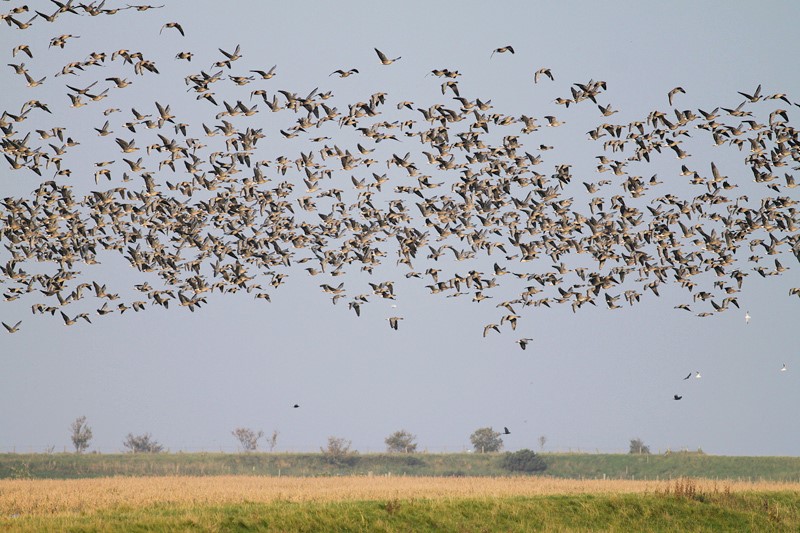
Here is a summary of bird counting techniques methods which I and many other birders use when out in the field. I dotted the text with photographs of groups or flocks of birds for readers’ on-going practice and consideration. 

Many birding projects ask participants to count birds, and most birders I know enjoy keeping a count of the birds they see whenever they are in the field. Counting each individual bird seen can be challenging, but it can also provide valuable information for scientific research. As populations of birds change, mostly downwards, fluctuations in counts at the same locality at the same time of year may indicate shifts in pollution levels, habitat loss, migration timing and more. 

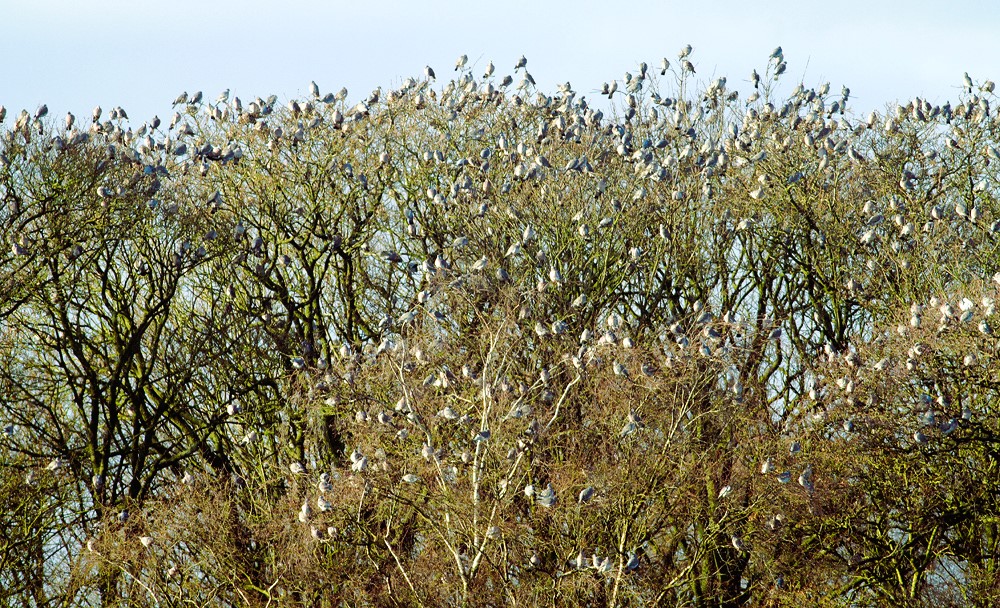
One is simple even if it does fly off as soon as the shutter activates. After that things become more difficult.

Little Egret - One


Woodpigeons - How Many?

Annual projects such as the Breeding Bird Survey, Common Birds Census, Garden Bird Survey, BirdTrack, Wetland Bird Survey or the Ringing Scheme are different types of bird census projects which over several years accumulate a massive amount of data about numbers of birds in different locations. The data would be impossible to gather without the help of every participant. However the more accurate a count is, the more useful the data is for conservation projects and ornithological research. 

There are various ways to count birds depending on the birds present, the size of the flock and how the flock is behaving. Techniques include: 

Individual Counts: When just a few, recognisable birds are present, each individual bird can be easily counted without fear of major miscalculations. This basic one-two-three technique works best when the birds are clearly seen and slow moving so that individual birds will not be counted multiple times.

Grouping: Counting birds in numeric groups is an easy method for totalling small or medium-sized flocks. With practice birders can easily learn to count birds not one by one, but five by five, ten by ten, and with practice, fifty by fifty. This allows for a faster count while still keeping the increments small enough for precise numbers. 

Oystercatcher - 240/260?

Grids or Counting in Blocks: This counting system is most often used with larger, single species flocks where the birds are relatively stationary. The field of view is divided into a grid or block of even sections where the birds in one section are counted as close to individually as possible. Multiplying this count by the number of grids or block sections in the flock can give a reasonable estimate of the total number of birds. 

Whooper Swan - circa 65/70?

Selective Counting: When a large flock of birds has some obvious mixed species, it may be possible to selectively count all the birds easily. First, pinpoint the more unusual birds in the flock and count them individually, then use the grid/block technique on the bulk of the birds. This provides not only a good count of the flock size, but also represents the diversity of the birds present. 

Proportions: When a mixed flock has too many species for selective counting, a good estimate can be made by counting proportions of the species present. Similar to the grid/block technique, only one section of the flock is counted, but each different species is noted individually, and the proportions are used to calculate the total number of birds of each species in the entire flock. This technique is best when a flock is heavily mixed and each species is spread throughout the flock. 

Timing: When a flock is moving quickly, it can be impossible to create a grid/block or to count birds individually, since the movement will obscure other birds and make any estimate less accurate. A timing count can be used by focusing on a fixed point the flock is passing, and counting the number of birds passing that point in a certain period of time, such as a few minutes. Then the entire amount of time it takes for the whole flock to pass is noted, and the count is multiplied by the number of increments in that overall time to gauge its full size. This system can also be employed during times of visible migration or massed flight e.g. Swallows, Meadow Pipits or finches passing overhead or through a fixed point. 

Wigeon - circa 70?

Photographs: A digital photograph can be used for an accurate count if the entire flock can be photographed. The photo is then manipulated on a computer or printed out and individual birds are marked off as they are counted. This is a time-consuming method but can be very precise for a reliable count when high levels of accuracy are necessary. 

Sanderling - 65/70?

Practice is essential to develop and refine bird counting skills. The more frequently someone counts birds, the more comfortable they will be with each count made while knowing the data collected is accurate and therefore more valuable. Other ways to enhance the methods of counting birds include: 

Maintaining a notebook at hand to write down a record of birds counted, particularly when counting over a longer period of time. With notes there is less need to “guesstimate”. 

Allow for density when counting flocks, particularly when using grid or timing techniques. Birds are often less dense on the outer edges of the flock, and if grid sections are not balanced a count can be significantly off. 

Work to be as accurate as possible, but when necessary, choose to underestimate rather than overestimate the numbers of birds seen. This will help correct for any inadvertent errors, such as birds that were counted more than once. 

Counting birds can add a new dimension to birding, by not only keeping track of the numbers of birds seen but also making the birding so much more purposeful and useful for conservation science. 

Remember that counting birds may not be an exact science but it is a highly enjoyable one. 

Pink-footed Geese - +500? 

Meanwhile, and in view of the parlous state of  many bird species, I think that very soon there will be very few birds left for anyone to count.

For those of a certain age. Does the Joni Mitchell song from 1961 ring a warning bell?

Insert the word "birds" in place of "trees"

Don’t it always seem to go

That you don’t know what you’ve got ’till it’s gone?
They paved paradise, put up a parking lot.

They took all the trees
Put 'em in a tree museum
And they charged the people
A dollar and a half just to see 'em 


Please log in to Another Bird Blog soon - I'm counting on it.


Saturday, August 31, 2024

Blog Post

I suddenly realised I had not blogged for ten days or more and mentioned to Floridian friends that I currently lacked inspiration for the task. It’s OK for them living in a 365 day sunshine state where a single nature reserve like Withlacoochee River State Forest consists of nearly 60,000 acres to explore! If there is anywhere here in the UK with a spare 60,000 acres, brown paper envelopes change hands and the said acres disappear under concrete in the blink of an eye. 

Gini who is wise in all things, advised me to “just slap the keyboard until a few words pop onto the screen, call it a “blog post” and her and Wally would supply the enthusiasm.” Here we go then Gini. 

The week began with good numbers of Swallows on the move. On Tuesday, an overcast mizzly morning, we drove to Garstang for food shopping and bacon butty day when it became quickly apparent that Swallows had hit their pathways south. They whizzed back and forth, left to right, feeding like mad but with a certain southerly slant. Four hours later and on the same road back there was hardly a Swallow and by this Saturday morning’s patch visit, none. Autumn had begun in earnest. 
 
Swallow

Most, about 90-95% of those migrating Swallows off to South Africa would be birds of the year, born this summer and now heading off into the unknown with just their DNA and the company of others to guide them. Magical. 

There was no ringing this week. Sidekick Andy was indisposed and mostly windy days meant that camera days came into play. 

The Common Kingfisher is an autumn and winter visitor to this part of coastal Fylde where sheltered ditches and dykes sustain a surprising number of easily missed birds. A flash of disappearing pale blue is often the view that many people experience. I snapped one midweek on a habitual gate post that is located alongside said dykes. 

Kingfisher

Kingfisher

I photographed a Little Egret in a couple of unlikely poses. Maybe it was drying out in the sunshine rather like a Cormorant or simply watching the water and reeds below and hoping for a meal? 

Little Egret

Little Egret

A young Yellow Wagtail quite liked the farmer’s midden, one of a number of wagtails on the move this week.
  
Yellow Wagtail

More than a couple of Marsh Harriers came my way. A once scarce migrant the harrier is now well established in parts North, South, East and West of here and from where its spring and autumn migrations mean it is now regularly spotted. I hear that this year a pair bred in the uplands of the Bowland Hills, an area more famous (or infamous) for the trials and tribulations of the persecuted Hen Harrier. 

The young Marsh Harrier seen here was hunting fields close to 13th Century Cockersands Abbey.

Marsh Harrier

Cockersands Abbey
 
It’s a good spot to see a Marsh Harrier or watch Wheatears using the ancient rocks as look out posts or listen to the wild cry of Curlews, much like the monks of old in around 1200AD. 

Wheatear

Saturday morning saw large numbers of Buzzards kettling as they dispersed south, a not unknown phenomena in the Fylde but made noticeable in recent years by the downturn in our local and somewhat persecuted population of Buzzards. 

The Buzzard is not a species ringed in any great numbers and one that in a dead or dying condition is probably unlikely to be reported, more so if the finder is a person with a mind to harm the species.; therefore we know little about these individuals but it seems likely they originate from less populated parts of Northern England & Scotland and disperse south & west for the approaching winter. 

Buzzard
 
Although Buzzards are known to eat mammals, birds, carrion, even earthworms and large insects when other prey is in short supply, their propensity for taking leverets and game birds released for shooting makes the species unpopular with some communities. 

The week ended badly on Friday as wine o’clock drew close we realised that the Portuguese bottle on the dining table had a cork stopper and our trusty waiter’s friend had gone missing. Panic set in until we found an Italian screw top bottle. We followed on with a quick search on Ebay to find and order a bright yellow replacement friend just in case we require a bottle opener later in the week.  

Waiter's Friend

Sue and I are not fans of most screw tops, metal closures invariably found on cheap wines with meaningless, made-up labels that try to hide the fact that it is bulk wine sloshed around in a rusty container for months on end to be eventually bottled at a Warrington post code adjacent to the Manchester Ship Canal. No thanks. 

Cork has centuries-old tradition behind it, a little like us. 

How did I do Gini?

Back soon if Wally and Gini OK this post.


Related Posts with Thumbnails