Friday, March 22, 2013

Taking Stock

Indoors today surrounded by rain, snow and even blizzard conditions in the hills not far away, with more to come the experts promise. So here's the news from yesterday, before the weather went from not good to infinitely worse..

Despite the early sun Thursday morning began as yet another bitterly cold one with a biting easterly breeze. It was a combination which left few choices about the outing, the main priority being to bird somewhere moderately sheltered where there might be a touch of warmth in the air. 

So it was over the moss roads to the Rawcliffe feeding station to take stock of the birds there, a top up of the niger tubes and  a scattering of mixed seed on the deck. I stopped on the way along Lancaster Lane to look for birds on a still partially flooded field where I found a couple of shire horses to say hello to.

Pilling Moss

Shires

The flood held five or six Meadow Pipits and more than 15 alba wagtails, all Pied Wagtails I think, until my viewing was interrupted by their multiple alarm calls as a Peregrine flew overhead going in the direction of Pilling and the shore. The wagtails settled in another field further away where 6 Fieldfares probed through the mud for worms and a pair of Oystercatchers has taken up residence. I think the oyks should wait before laying eggs as most fields are being ploughed now after a cold but dry spell which has left the ground generally workable. 
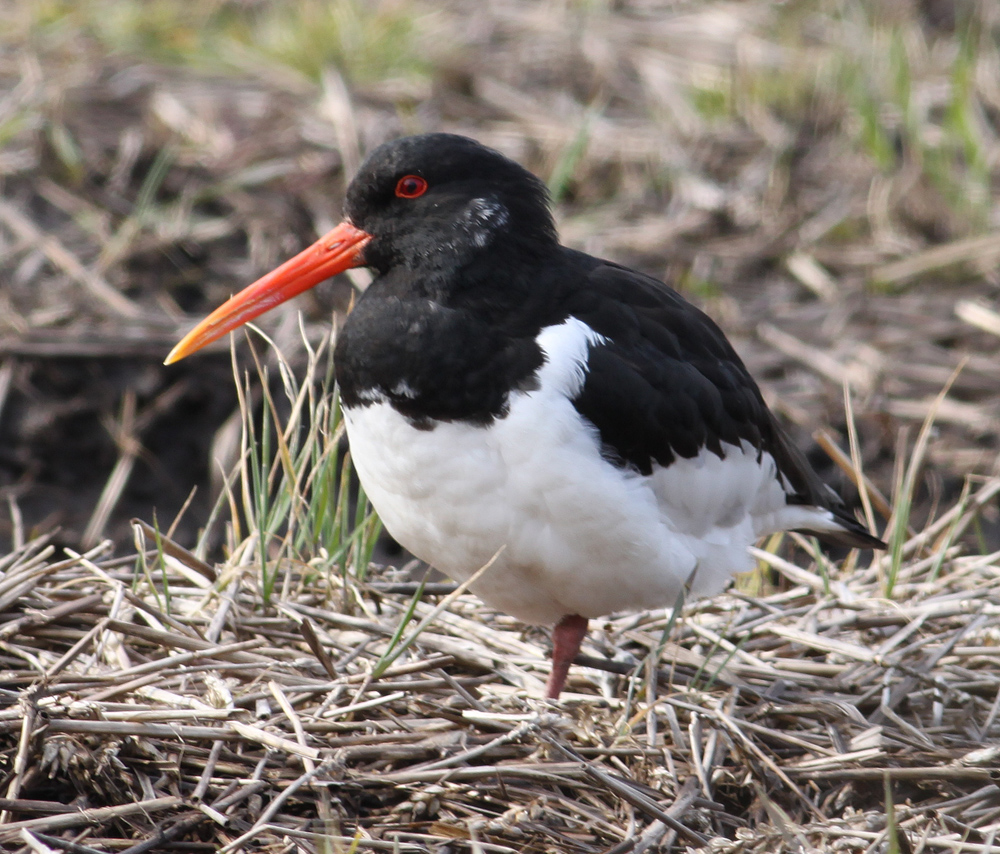
Oystercatcher

Towards Out Rawcliffe I saw the first of four pair of Buzzards I would see, this couple joined in the air by the inevitable crows but also by a Sparrowhawk. Buzzards are extremely active now after many adopted a wintering low profile or moved south and west for a while. 

Buzzard - Buteo buteo

Last week a reader asked about our UK Stock Dove, the pigeon that is somewhat ignored by us birders seeking something more colourful or exciting. Near Out Rawcliffe I watched a pair of Stock Dove at a broken down old tree, a tree which has served Kestrels. Little Owls and Stock Doves in past years but which is now in serious decline - Rather like the Stock Dove itself, a species which has suffered sharp losses of habitat combined with pressure from hunting.

Stock Dove

And from Wiki - "The name Stock Dove has caused some confusion about the origins of this bird. The modern usage of the word "stock" might imply that the bird has been tamed and kept as stock for food and merchandise, leading to the belief that this bird is a hybrid breed with its origins in human aviaries; however this is not the case. The word "Stock" refers not to the stock of trade, but comes from the Old English "stocc" meaning "stump, post, stake, tree trunk, log." Therefore "Stock Dove" means "a dove which lives in hollow trees". Such hollow trees near human settlements would often be taken and used as wood stock for firewood, hence the name”. 

 Stock Dove

“Before deforestation, the Stock Dove was the most frequent pigeon, nesting mostly in oak or pine wood, but as it usually nests in cavities in trees it was normally only found in old forests. In plantations there are not as many holes to nest in, so the species is scarcer. In addition, because the Stock Dove is double brooded, a second hole is required for the second brood. They are known to nest in rabbit burrows, ruins with cavities large enough to host nesting and old poplar hedges which have numerous cavities for nesting and in cracks in crag or cliff faces, in ivy, or in the thick growth round the boles of common lime trees. Stock Doves will also use nest boxes”.

About the farm one or two Curlews were in bubbling display as they passed through and east towards the Bowland fells, and I counted more than 20 of them heading that way. The feeding station still holds the Bramblings, 4 today, plus 15 Reed Bunting, 10 Chaffinch and 6 Goldfinch. 

At a nearby garden were 30+ Tree Sparrows, 1 Great-spotted Woodpecker and 1 Mistle Thrush. Four more Buzzards, 60+ Woodpigeon, 4 Yellowhammer and a pair of Kestrels completed my morning. 

Yellowhammer

If there’s anyone not entered Wednesday’s draw on Another Bird Blog to win a copy of the new Crossley ID Guide: Raptors, there’s still time to do so by clicking here.


Good luck and come back soon. Meanwhile see Who would rather be birding or take a look at Madge's Weekly Top Shot.

Wednesday, March 20, 2013

Blog Tour - Crossley Raptors UK - Free Book Draw

Yes this is it folks, and if you reached here today via Princeton University Press Blog or Birdfreak.com you will know what this is all about. For regular readers of Another Bird Blog today’s post is a little different in the form of a whistle-stop on a transatlantic blog circuit organised by Princeton University Press, a tour of Internet birding and featuring Richard Crossley’s new book The Crossley ID Guide:Raptors. 

Readers will remember Richard’s Crossley’s innovative and highly successful book The Crossley Guide:Eastern Birds, reviewed here on 27th January 2011. The post became the most visited page on Another Bird Blog with more than 1200 hits to date. The book became a huge success and Richard is now following it up by joining forces with Brian Sullivan and Jerry Liguori to co-author this new volume which takes a detailed look at North American raptors.

As part of Another Bird Blog’s contribution to this circuit and further down the page there is a draw whereby two lucky people will each receive a copy of The Crossley ID Guide:Raptors. All you have to do to be in with a chance is answer a simple question. So read on but don’t skip the middle bits which may give a clue as to the answer to my question. 

This new book may be produced in the US but let’s not forget the UK and the US share not only chunks of our history and culture but also a number of birds of prey and occasional transatlantic passerine and wader vagrants.  There’s a healthy interchange of bird watchers too, with US birders heading to Europe as well as many UK birders visiting US raptor watching stations and bird observatories or taking birding holidays.

I looked through the The Crossley ID Guide: Raptors to find the species common to both nations, the familiar birds which UK birders might see over in the US, and the regular species a US birder might well see in the UK. We share species, but we often like to name them slightly differently, a whimsy of our respective ornithological systems, so I will list the species and include both name versions where appropriate, US version first followed by the UK name and then finishing with the Latin name:
  • Merlin Falco columbarius
  • Northern Harrier/Hen Harrier Circus cyaneus
  • Rough-legged Hawk/Rough-legged Buzzard Buteo lagopus
  • Peregrine Falcon Falco peregrinus                         
  • Gyr Falcon Falco rusticolus 
  • Northern Goshawk Accipiter gentilis 
  • Osprey Pandion haliaetus 
  • Golden Eagle Aquila chrysatos 
There may be several thousand miles of ocean separating the US and the UK, but there are subtle variations as well as the obvious similarities, with just a few of those detailed below.

In the tiny landmass of the UK our Merlin is the singular species of Falco columbarius. In the vast continent of the US with its huge variety of habitats the Merlin has evolved into three sub-species differentiated mainly by the darkness of their plumage. There is a dark form, the so called “black” Merlin of the Pacific Northwest, a pale “prairie” Merlin of the northern Great Plains, and the intermediate “taiga” Merlin of open forest. It’s the latter type which is equal to our familiar UK Merlin.


Following a number of variable plumages seen in the UK autumn time, there’s been discussion here about the possibility of Northern Harrier/Hen Harrier Circus cyaneus being two species, a North American one and a slighly different European/UK type. The jury, in this case the International Ornithological Committee, examined the evidence and decided not to split as the genetic differences between the two are very low in comparison to many other Eurasia/North America disjunctions. 

Northern Harrier/Hen Harrier - from The Crossley ID Guide: Raptors

Happily both of our Peregrine populations are in a healthier state since the ban on DDT of the early 1970s which led to a recovery in numbers. This has been supported by large-scale protection of nesting places and a reintroduction programme in the many parts of the US. In both our countries the Peregrine has reoccupied former haunts and they now breed on human artefacts in our city centres. There are three subspecies of Peregrine Falcon in the US, tundrius of the north, anatum found mainly in the Rocky Mountains, and pealei which is found in the Pacific Northwest. Peregrines introduced into the eastern and other states are of mixed races. Here in the UK our Peregrine Falcons are from the nominate (first named) race Falco peregrinus peregrinus.  

Rough-legged Hawk/Rough-legged Buzzard Buteo lagopus is but a very irregular winter visitor to the British Isles, spreading here from continental Europe, generally during times of intense cold weather and/or shortage of their lemming/mammal prey. This situation rather simplifies separating out our everyday UK Common Buzzard Buteo buteo, unlike the US landmasses where 10 species of Buteo occur, all of which feature in The Crossley ID Guide:Raptors.

Rough-legged Hawk/Rough-legged Buzzard - from The Crossley ID Guide:Raptors

The Gyr Falcon is incredibly hard to see in the UK, and just like the Rough-legged Hawk the pale Arctic falcon is a very irregular visitor to the UK mainland. As Crossley has described its status in the US, “a loner with a huge territory”, an accurate portrayal for a bird which spends much of its time hunting across the northern oceans.

In the US the Northern Goshawk is a widespread but scarce breeder of forested areas. It's a status replicated over here in the UK, whereby spotting a Goshawk makes for something of a birding Red Letter Day.

Northern Goshawk - from The Crossley ID Guide:Raptors

Ospreys are a common sight in in many parts of the United States, whereas in the United Kingdom the species is confined mainly to Scotland with just a small number of pairs breeding in the more remote parts of Wales and northern England. In the English counties Ospreys are a regular sight on migration during both spring and autumn periods.  

Last but not least on my list is the magnificent Golden Eagle, a species which in both the UK and the United States breeds only in the more remote northern forests and mountains. Here in the UK our Golden Eagles are confined to the inaccessible parts of Scotland and rarely venture south across the border into England. 

And now without further ado the prize draw - at last you say. There is a small, colourful  raptor featured in The Crossley ID Guide: Raptors which has occurred in the UK on less than a handful of occasions, in fact just two accepted records, so few that while it belongs on the Britsh List of birds as maintained by The British Ornithologist's Union's Records Committee (BOURC), I didn't include it in my summary of shared species above. The last occasion this raptor appeared in the UK as a vagrant was during the late 1970s, over 35 years ago. What is the species? Please post your answer as a  comment to this post before 27th March 2013. Two winners will be chosen at random, and due to logisitcs, one from the US and one from the UK. The winners will announced on Another Bird Blog on 28th March and requested to send me (in confidence) their postal address. In due course each winner will receive a copy of The Crossley ID Guide:Raptors courtesy of Princeton University Press.

As part of this two-week blog tour raptor enthusiasts are invited to join in a live Shindig video chat event on Friday 22nd March - "Raptor ID Happy Hour" from 6pm to 7pm EST at  Shindig's Raptor Event. Two of the participants are the authors themselves, Richard Crossley and Brian Sullivan - sounds like a good place to be on a Friday evening with a glass of beer close to hand.

Next stop on today's blog circuit is a trip to Radd Icenoggle in Montana USA where Radd's Blog is looking back at the Montana State recovery programme which rescued the Peregrine Falcon from the verge of extinction in that region. Following on from Radd the Magnificent Frigate Bird web site will feature Barred Owl and Cooper's Hawk and there's another chance to win copies of The Crossley ID Guide:Raptors.


Finally and before you head off to Montana with Radd, don't forget to enter today's prize draw on Another Bird Blog and then come back soon to find out the winners of the fabulous prizes.


Tuesday, March 19, 2013

Why Worry?

I can’t be bothered chasing about trying to see the first Wheatear or the first Chiffchaff while the weather remains so cold. The birds will come when they are ready, as soon as they sniff warm air up ahead, but there’s no sign of that happening today with another early morning frost. 

In the meantime there are still a few wintering birds about too, as I found out when I topped the feeding station up on the moss. Just 12 birds caught, of which seven were new, 3 Chaffinch, 2 Brambling and 2 Reed Bunting. The other 5 were recaptures of 2 recently ringed Bramblings and 1 each of Goldfinch, Coal Tit and Chaffinch. So it looks like I need to make the effort for more ringing sessions until the finches depart north. 

A male Chaffinch this morning gave an enormous reading on the scales at 28.1 grams, a weight which later on may cause the database to “beep” as a potential input error. Upon checking the weight and examining the bird I found stored fat bulging from the chest cavity. It’s probably a bird going a fair old distance soon, just like the Bramblings heading off to Scandinavia or Russia. 

Below is the fat Chaffinch and then one of the morning’s Brambling, both birds second calendar years. 

Chaffinch

Brambling

Coal Tit

Goldfinch

A few Meadow Pipits overhead this morning, less than five and no other signs of spring arrivals, just wintering and resident birds: 5 Buzzards in the early sun, 6 Yellowhammer, 15 Chaffinch, 8 Brambling, 15+ Reed Bunting, 2 Kestrel, 12 Corn Bunting 

Today's post is linking to Australia and  Stewart's photo gallery.

Don’t forget, tomorrow on Another Bird Blog there's the chance to win the new Crossley ID Guide: Raptors, so don’t miss it. 

Don’t worry if you miss out on the book, I’ll point you in the right direction to order a copy.

Sunday, March 17, 2013

Believe It Or Not

The BBC forecast for Sunday morning wasn’t too good. By “not too good” I mean inaccurate, and despite the promise of rain I managed to squeeze a few hours ringing out of the dry, bright and calm morning before rain appeared about 10am. The temperature remained at close to 1⁰C for most of the morning in what’s shaping up to be the coldest March for a number of years. 

There was the usual stuff, just four species caught 12 new birds - 5 Goldfinch, 3 Reed Bunting, 2 Brambling and 2 Chaffinch. In addition there were 7 recaptures of 5 Goldfinch and 2 Reed Bunting. 

The winter ringing totals of new birds Nov to March for those four species at this feeding station now stands at 85 Chaffinch, 60 Brambling, 54 Reed Bunting and 45 Goldfinch. There has been exactly the same catching effort given to all species and the figures show how there is a constant turnover of birds at feeding stations, or indeed in any location where birds feed, whether gardens or farmland situations like this one. 

Perhaps most surprising of the above figures is the closeness of the Chaffinch and Brambling totals given their normal and relative abundance, even in years of immigration from Europe. Perhaps this is an indication of how many Bramblings remained undetected in the mixed flocks feeding on the stubble fields of recent months? There were large congregations of finches which upon only casual examination, and given the difficulty in observing them closely for more than a minute or two before the birds took flight, may have appeared to be Chaffinches only.

Of course even a brief view of a departing Brambling doesn’t always reveal the white rump. And a partly hidden finch shape in the top of a tall tree on a grey winter’s day doesn’t always expose the orange tones of a Brambling, more so if it’s an inconspicuous female. 

Brambling

Brambling

Brambling

Many Goldfinches are now in immaculate breeding plumage, even as others retain the last of their buff, juvenile head colouration or display last year’s tail. 

Goldfinch

Goldfinch - second calendar year

Goldfinch - last year's tail

There was another hint of returning Goldfinches today with a couple of older recaptures from previous breeding seasons: also nearby a flock of 40+ Linnets, a species which has been conspicuous by its absence this winter. 

Birding-wise the morning was unremarkable, perhaps the most noteworthy being a gang of approximately 90 Fieldfares heading strongly North East. Others: 1 Barn Owl at dawn, 1 Sparrowhawk, 5 Yellowhammer, 2 Corn Bunting, 2 Great-spotted Woodpeckers, 4 Buzzard, 35 Woodpigeon, 2 Stock Dove at a nest hole again. 

The Stock Dove picture is for Anni, a pal in the USA. 

Stock Dove

There’s no permanent ringing station here on the moss. There's just the parcel shelf of a hatchback with no Agas or steaming kettles, not a heater in sight, nowhere to warm your icy feet, and absolutely no creature comforts apart from a poorly made flask of rapidly cooling coffee. And it’s hell having to look at all those wonderful birds up close. Honest. 

The Ringing Hut

Make sure you log into Another Bird Blog next week when two lucky readers will each win a copy of the brand new, yet to be released Crossley ID Guide: Raptors. You’d better believe it.

Thursday, March 14, 2013

Normality Resumes

The day to day ringing must go on, and after Wednesday’s surprise catch of the Little Bunting today’s effort was bound to be a more mundane affair. So it proved, a very slow morning saw just 9 birds caught, 4 new and 5 recaptures. Four new comprised 3 Chaffinch and 1 Brambling, the five recaptures 2 Reed Bunting, 2 Brambling and 1 Chaffinch. 

With very few birds about the area I had the distinct impression that the finch flocks of recent months are now well and truly finished and flown to pastures new: the three new Chaffinches were all on the larger size ( 2 x females at 86mm and 1 x male at 93mm) suggesting they may be heading east and north rather than staying in these parts. If the ringing was sluggish the signs of spring were equally so with nothing resembling the March migration that can occur in warmer periods. Last March I was busy catching dozens of Lesser Redpolls as Meadow Pipits and wagtails headed north over my head, but with the current cold weather and northerly winds migration will be delayed. 

There are just token photographs from the ringing today, but maybe a Lesser Redpoll portrait soon? 

Brambling

Chaffinch

There were a few signs of Spring, mainly in the form of 3 loudly drumming Great-spotted Woodpeckers at dawn, this followed quickly by a Corn Bunting singing from the annual tree; I don’t know what the Corn Bunting will do if that tree disappears. 

Other sightings: 1 Barn Owl, 3 Buzzard, 4 Kestrel (2 pair), 2 Stock Dove (pair), 14 Fieldfare, 2 Jay, 1 Grey Heron, 4 Shelduck, 12 Tree Sparrow, 8 Corn Bunting. 

So there’s yet another Kestrel photo. 

Common Kestrel

The Robin waited patiently for breakfast again this morning, the light falling in a better direction for a portrait. What a Little Stunner our common or garden Robin is, much better looking than a Little Bunting! 

Robin

Click your way to Another Bird Blog very soon for more news and pictures of spectacular birds, rare or otherwise. Linking to Weekly Top Shot  and  I'd-rather-b-birdin.blogspot.with Mr Robin above.

Wednesday, March 13, 2013

A Little Bunting Day

The intention was to just fill the feeders and drop more seed for the hungry Bramblings at Rawcliffe, and then do a little birding, leaving the ringing for the better forecast of tomorrow. With the wind speed nil and a number of birds around I decided to stay for a while, until that is the wind picked up about 1030 and forced me to close the nets. 

In the meantime more Bramblings appeared in the nets along with a national rarity, a Little Bunting Emberiza pusilla. Little Buntings breeds across the taiga of the far northeast of Europe and northern Asia. It is a migratory species wintering in the subtropics of northern India, southern China and the northern parts of Southeast Asia. It is a rare vagrant to Western Europe and the UK. 

Birds caught: 4 Brambling, 3 Reed Bunting, 2 Chaffinch, 2 Goldfinch, 1 Little Bunting. 

The Little Bunting was in a net alongside two Reed Buntings, the Little Bunting immediately recognisable because of its diminutive size, fine, straight bill, distinctive head pattern, obvious whitish eye ring and pink legs. The measurements were equally tiny, a wing length of 68mm and a weight of just 12.7 grams. 

Little Bunting

Little Bunting

For comparison with the smaller bunting, one of today’s male Reed Buntings. 

Reed Bunting - Emberiza schoeniclus

More Bramblings today takes the winter November to March total here to 55, so definitely something of a “Brambling Winter” with the second highest yearly total of this species for the ringing group. The Reed Bunting total for the same winter period stands now at 49 birds as the buntings continue to roam local farmland, eventually finding their way to my feeding station. 

Brambling

Brambling

Mentioning Reed Buntings reminds me  of a couple of recent records of their local autumn/ winter wanderings. The first involved a young bird Y763574 ringed in the summer of 2012 on July 30th at the Leighton Moss RSPB reserve, near Silverdale. I recaptured the bird at Rawcliffe Moss on 5th January 2013, a distance of just 34 kms - a fairly typical way that Reed Buntings seem to roam during autumn and winter. 

A second record involves Y279071, a first calendar year Reed Bunting caught at Out Rawcliffe on 25th September 2011 and later caught by another ringer at Knott End on 29th January 2012. This bird too shows another typical short distance movement of just 10kms. 

Reed Bunting movements

More bird news and pictures from Another Bird Blog soon. Stay tuned.

Monday, March 11, 2013

Snowy Scene

What a strange day for birding. There was a bitterly cold easterly wind as the BBC said there would be, but one minute I’m out in the sunshine enjoying a good bit of birding, and then two minutes later scurrying for the car to escape horizontal snow showers. Listening to the radio and waiting for the shower to stop it seems the maritime Fylde is surrounded by snow to the north, east and south once again. 

Sunny Showers

It's On The Way

Snow Shower - Out Rawcliffe

I was out on the moss again topping up the finches with niger and their regular seed mix, and not before time after being unable to get there yesterday. The birds are becoming quite astute, disappearing as soon as I approach the dropping point, and then by the time I stand there filling the feeders the place is devoid of birds. A stranger to the site would quickly abandon any birding there on the assumption there were no birds to see. After a while the finches return allowing a count of sorts as 10 Brambling, 15 Chaffinch, 6 Reed Bunting, 8 Goldfinch, 2 Yellowhammer, 4 Blackbirds and a Song Thrush. 

The Robin often waits near the car hoping for seed spill when the car stops and a gust of wind blows spilled seed from the open hatchback.

Robin

More interesting today was the number of birds on nearby stubble, most of them visible only when a Hen Harrier motored in from the west in fly-fast surprise rather than slow-quartering pounce mode. As it flew rapidly over the fields the harrier dislodged 120+ Skylark, 35 Corn Bunting, 18 Fieldfare, 60+ Woodpigeon and 90+ Starling from just one field as pandemonium took hold. With so much food in the offing and snow still blanketing the hills, no wonder the harrier is staying put for now. 

Hen Harrier

Snow in Bowland

The car window was down and as I drove further down the farm a female Sparrowhawk came off the roadside and then flew in and then out of the adjacent wood to escape attention. The hawk wasn’t unnoticed by the resident Tawny Owl though, the owl giving out a couple of territorial hoots to see off the Sparrowhawk. That  ploy worked well enough on the hawk but made me head into the wood instead. I found the Tawny in what looked like a well-used roosting spot of a low, ivy covered stump of a tree. No sign of its mate which could well be sat on eggs by now and keeping those snowflakes at bay. 

Tawny Owl

Other bits and bobs today - 1 Grey Heron, 1 Mistle Thrush, 30+ Tree Sparrow, 1 Kestrel, 1 Buzzard, 1 Little Owl. 

Little Owl

More soon from Another Bird Blog, but just for a change of scene and a hint of what’s on the menu here next week, try Princeton University Press Blog .

In the meantime today I'm linking up with Stewart's photo gallery.

Friday, March 8, 2013

Friday Fix

With a cold easterly breeze and full grey cloud the morning held spits of rain, as well as the promise of more to come, so kicking my heels I waited until the sky brightened a touch then headed out Pilling Way hoping to finish Friday with a flourish. 

I gave the Fluke Hall and Ridge Farm area a decent going over without finding anything spectacular, least of all an early Wheatear in such unpromising conditions. A number of Pied Wagtails were searching the recently ploughed fields and the roadside midden where more than one local family dump their horse manure, the resulting gunk as good a place as any to look for feeding birds. Mixed in with the mainly wagtail flock were a couple of Meadow Pipits, 6 or 7 Skylarks, and towering above the passerines 40+ Oystercatcher, several Lapwing, 4 Redshank and 3 Curlew, all burying their bills a little deeper than the small birds could manage. 

Oystercatcher

Pied Wagtail

Further back in the same field were 400+ Pink-footed Geese, a small sample of the several thousand out beyond the sea wall towards Lane Ends. All the geese took flight a little later when a light aeroplane flew over sending the birds in the air for a few minutes before they settled back to feeding on the marsh again. 

Pink-footed Goose

Other bits and bobs here and from the sea wall: 2 Mistle Thrush, 1 Reed Bunting, 5 Little Egret, and a couple of singing Chaffinches with calling females close by. 

Backsands Lane has dried out more than a little, birds there today restricted to 30 Redshank, 15 Lapwing, 10 Greylag and the resident Kestrel. From Lane Ends car park Pilling Marsh was a mass of distant grey geese, too far out to make anything of in the murky light. 

Cockerham proved better with a distant, albeit good selection of birds, mostly waders on the managed flood - 80+ Dunlin, 40 Redshank, 120 Golden Plover, 300 Starling, 15 Curlew, 1 Little Egret and 160+ Lapwing. 

Golden Plover

A number of male Lapwings were in full display mode, tumbling crazily over the field, showing off their flying skills to females below. I could see one of the females a distance away had a ring on its left leg, the bird too far away and the light too poor to read the inscription. 

Lapwings are not only long-lived but also extremely site faithful through generations and I wondered if this female was one of the hundreds of Lapwing chicks I’d ringed along this stretch of coast over many years - perhaps no, but possibly yes. More visits required in a week or two when the female will be there and perhaps much closer, looking after a clutch of youngsters and still displaying the evidence of an earlier day in my company when I gave her a shiny new ring.

Lapwing

More visits required to Another Bird Blog too - log in soon for more birds and birding.

Today's post is linking to Madge's Top Shot  and to Anni's Birding Blog

Thursday, March 7, 2013

Blown Off Course

Morning rain put paid to any huge ambition today, so when the rain cleared about midday leaving little wind but with a grey sky I decided to head to Rawcliffe where I could check the feeding station. 

There seemed to be a decent number of Chaffinch and Brambling about again, all scattering from the seed drop zone as I approached, so I put up a couple of nets before leaving a couple of litres of seed. I caught just three Bramblings, 2 new and a recapture from recent days before the wind sprung up unannounced causing me to take the nets down again. It was very annoying again after a similar episode last week, but the few Bramblings pushed my total here to 51 new ones during the full winter period. 

When I looked at the data on IPMR these birds split as 42 juvenile/second calendar year and 9 adults roughly 50/50 each sex.

Brambling - second calendar year male


Brambling - second calendar year male 

It stayed dry but very overcast so a little birding was in order. Finches around the feeding area totalled 10 Brambling, 10 Chaffinch, 14 Goldfinch and 4 Reed Bunting, a reduction in recent numbers. I note that after the recent dry spell many fields which remained as stubble throughout the winter have now been ploughed, thus leaving less fields for finches and others to feed in. If only we could have such stubble fields every winter, as we used to do before farmers took to winter crops. 

Buzzards are a permanent fixture here on the moss with the 4 individuals I saw today in the overcast skies representing 4 breeding sites I know of, with many more not too far away. Other raptors pm were a Sparrowhawk molesting one of the above Buzzards and a Peregrine which came from the direction of Pilling and scattered roughly 90 Woodpigeons from the tree tops of the nearby conifer plantation. 

Over towards Lancaster Lane the Lapwings and Starlings indulged in periodic panic with many hundreds in the air together at times giving rough counts of 280 and 600 respectively. A couple of Lapwings have now taken up residence on the farm in the same areas used in previous years. 

Other sightings: 60+ Curlew heading north, 2 Yellowhammer, 18 Corn Bunting, 40+ Tree Sparrow, 4 Song Thrush (2 pairs) and 9 Roe Deer. 

The nine deer were in separate groups of 4 and 5 animals. As an aside, and from the national newspapers today - “There are currently around 1.5million deer in the UK, and experts say that unless numbers are managed, the deer population will escalate out of control and they will soon be considered vermin”. I wouldn’t say deer are a major problem around but I know they break through electric fences causing valuable livestock to wander and to occasionally get lost. 

Roe Deer

Back to the birds. The Corn Bunting picture was taken on a sunnier day than today but it’s the tree the buntings always fly to when they have been disturbed from their favoured feeding spot. 

Corn Bunting

A bit of a short day and a rather undersized post but please tune in to Another Bird Blog soon for the better birding experience.

Related Posts with Thumbnails